


Don’t miss out!
Take Advantage of this limited offer from Creation Press. The first 100 free subscribers will automatically be upgraded to a paid account for one year and enjoy serialized Christian fiction straight to their inbox.
Can’t stop using Porn?
Transform your life with the Victory in Christ course! Join our 10-week program for structured guidance, supportive community, and powerful spiritual tools to overcome addiction and embrace your true identity in Jesus. Start your free trial and claim victory today!
Start Free Trial →
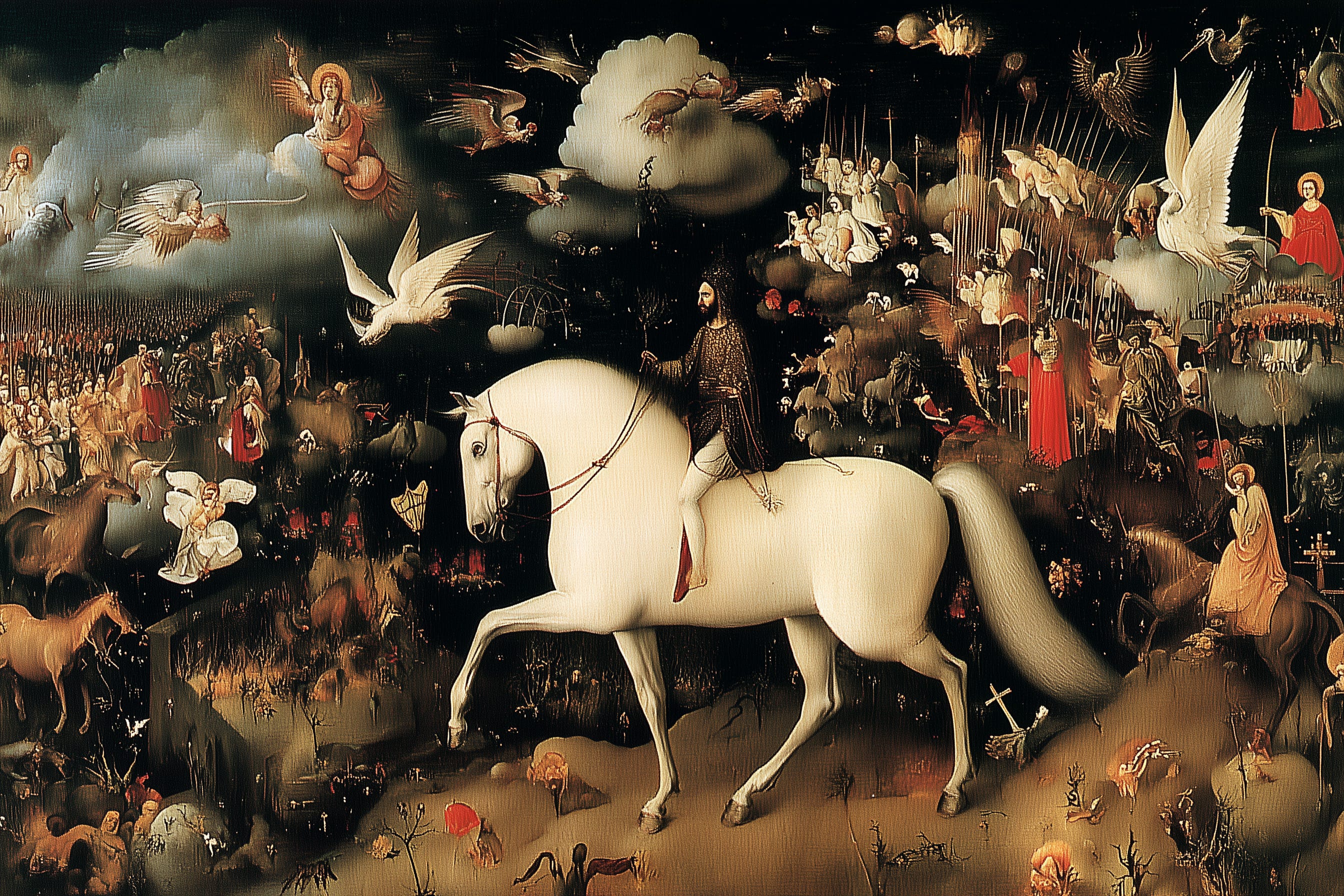

The sky tears open.
Not gradually. Not politely. But with the sound of finality—the kind creation itself has been holding its breath for since Eden cracked. The clouds roll back like a scroll and there He is: Faithful and True, seated on a white horse, eyes like blazing fire, crowned with many crowns. His robe is dipped in blood—not the blood of His enemies, but His own, shed for the redemption of the world. And from His mouth comes a sharp sword with which to strike the nations.
He rides forth—not as the suffering Servant of His first coming, but as the conquering King of His second. Darkness flees before Him. Death loses its grip. Every counterfeit kingdom collapses under the weight of His glory. The Lamb who was slain returns as the Lion who reigns, and the world finally sees that justice and mercy are not competing virtues but a single, holy flame in the heart of God.
And in that moment of blazing clarity, another truth becomes impossible to ignore:
Everything that pretended to be compassion but rejected His truth…
Everything that called evil good and good evil…
Everything that weaponized justice or counterfeited love…
—is unmasked for what it always was: darkness in disguise.
The same Jesus who will one day conquer every shadow has already revealed, in His death on the cross, the shape of true compassion, true justice, and true righteousness. Yet our culture tirelessly produces counterfeits—imitations that sound merciful but enslave, that sound just but destroy, that sound loving but abandon people to brokenness.
From Identity to Evil: The Big Story Behind the Series
Before we ever talked about evil, Creation Awaits walked through identity: God’s design, our brokenness, and the gospel that restores acceptance, significance, and security in Christ. We are image–bearers, created for communion and co-labor with God, and meant to receive our identity—not invent it—within His love (Genesis 1:26–27).
Brokenness enters when we source identity anywhere but God. The world’s labels become fig leaves that cannot cover our shame. The gospel, by contrast, makes us new creations, adopted children whose worth is anchored in Christ rather than in performance, politics, or pleasure.
The Evil series steps onto that foundation. If identity in Christ is the “who,” then this series asks about the “what” we are up against. The opening essay, “What Is Evil?”, defined evil biblically as anything—thought, desire, word, system, or act—that deviates from God’s good design because it mistrusts His character and re–labels what He calls good or evil. Evil is parasitic: it feeds on what God made good and twists it. It thrives where we trade the Father’s voice for autonomy.
Scripture shows that evil operates on multiple fronts:
The world – systems, cultures, and structures organized around rebellion against God (1 John 2:15–17).
The flesh – our inward bent toward self-rule and disordered desires.
The devil – the liar who manipulates both systems and hearts to oppose God’s kingdom (Ephesians 6:12).
The thief comes only to steal, kill, and destroy; Jesus comes that we might have life, and have it abundantly (John 10:10).
Every essay in this series is really a case study in that battle: how the world, the flesh, and the devil take something good—justice, compassion, equality, safety, empathy, free speech, even “love”—and weaponize it against God’s design.
Exposing Counterfeit Compassion in Our Age
1. When “Love” Blesses What God Calls Broken
Several essays tackled the ways our culture tries to baptize sin in the language of kindness and inclusion—trading holiness for affirmation.
“Affirming Sin is Evil – The War on Righteousness” shows that to affirm a sinner is Christlike, but to affirm their sin is evil. When we bless what God calls broken, we are not being compassionate; we are locking people into bondage. Human beings are designed to flourish in God’s righteousness, not in their addictions, idols, or identities apart from Him.
“Gender Pluralism is Evil – The War on God’s Design” confronts the idea that we can multiply genders beyond male and female. The series insisted that identity is not self-invented but received from a loving Creator who made us in His image as male and female, weaving dignity into our bodies and difference into our design (Genesis 1:26–27). Attempting to erase or remake that design in the name of compassion ends up deepening the wound; it asks fragile feelings to do a job only the Father can do—tell us who we are.
“Pedophilia is Evil – The War on Children’s Innocence” exposes attempts to recast predatory behavior as a sexual “orientation” deserving tolerance. Scripture calls God’s people to protect the vulnerable; pure religion is to care for orphans and widows in their distress, not to sexualize the least of these (James 1:27; Matthew 25:40).
“Abortion is Evil – The War on the Unborn” shows how our culture uses counterfeit compassion—“choice,” “healthcare,” “mercy”—to justify taking the life of children knit together in the womb (Psalm 139:13–16). The essay unmasks abortion as state–sanctioned violence against image–bearers, wrapped in the rhetoric of care.
“Legalism is Evil – The War on Grace” Instead of affirming sin, legalism crushes sinners under human rules. It is counterfeit compassion that values piety over love, using fear to manage people instead of trusting the Holy Spirit to guide them into all truth. Where legalism reigns, people conform outwardly while dying inwardly.
“Critical Race Theory is Evil – The War on Equality” challenges an ideology that tries to use racism to solve racism. By recasting entire groups as inherently guilty or inherently oppressed based on skin color, CRT abandons the biblical truth that all are equally fallen and equally redeemable in Christ. It offers a counterfeit equality that divides rather than reconciles.
In each case, the series presses the same point: love that refuses to tell the truth is not love. Compassion that never calls to repentance is not Christian compassion. Love rejoices with the truth even when the truth cuts against cultural slogans (1 Corinthians 13:6).
2. When “Justice” Becomes a Weapon
Another cluster of essays shows how the language of justice and fairness can be twisted into tools of control and punishment.
“Political Violence is Evil – Defining a Counterfeit Path to Order and Peace” exposes how mobs, riots, and assassinations pretend to bring justice but actually multiply chaos. They reflect the world’s belief that peace can be imposed by force rather than received through Christ’s kingdom way.
“Lawfare is Evil – The War on Justice” and “Judicial Activism is Evil – The War on Justice” reveal how legal systems designed to uphold justice can be weaponized against political enemies. When courts become tools for elites to punish dissent, justice is not served; it is mocked. Instead of doing justice, loving mercy, and walking humbly with God (Micah 6:8), lawfare uses the language of rights to crush the weak and shield the powerful.
“Censorship is Evil – The War on Free Speech” and “Cancel Culture is Evil – How Social Media is Weaponized to Punish Political Opponents” warn that when platforms, governments, or mobs silence dissenting voices in the name of “safety” or “hate speech,” they are not protecting people—they are protecting power. These essays highlight how cancel culture denies repentance and redemption, freezing people forever in their worst moment instead of honoring the gospel’s offer of restoration.
“DEI is Evil” tackles programs that promise diversity, equity, and inclusion but often enforce ideological conformity. When corporations act as unelected legislators, forcing beliefs and outcomes that contradict God’s truth, they circumvent government “of the people” and replace genuine justice with engineered outcomes that reward those who bow and punish those who don’t.
Together, these essays reveal a sobering reality: our battle is not against flesh and blood, but against principalities and powers that twist justice into an instrument of fear (Ephesians 6:12). They call believers to reject both apathy and rage and instead overcome evil with good (Romans 12:2, 12:21).
3. When the State Plays Savior
A third theme emerges where the state, or political ideology, tries to do what only God can do: save, secure, and sanctify.
“Political Idolatry is Evil – The War on Liberty” confronts both Christian Nationalism and Christian Socialism, exposing how left and right alike can try to accomplish the kingdom of God through the sword of the state. Whenever we expect Caesar to disciple our neighbor into holiness by force, we have traded the cross for coercion.
“Gun Control is Evil – The War on Self-Defense” argues that when the state monopolizes force in the name of compassion, it leaves the vulnerable defenseless while empowering those least likely to wield power justly.
“Open Borders are Evil” and “The War on Immigration” show how immigration policies cloaked in compassion can actually fuel human trafficking, incentivize dangerous journeys, and be weaponized to reshape political power through census and welfare systems. Migrants become pawns rather than neighbors.
In each of these arenas, the series calls us back to recognize the imago Dei in every person—citizen or foreigner, neighbor or political opponent—and to test every policy, left or right, against the grain of God’s design for human dignity and genuine responsibility (James 1:27; Matthew 25:40; Romans 1:28–32).
Why The Evil Series Matters
Taking the essays together, a pattern emerges:
Evil rarely marches in with horns and a pitchfork;
more often it arrives draped in compassion, empathy, fairness, safety, or progress.
The Evil series insists that Christians must learn to discern the difference between:
Mercy that heals and sentimentality that lies.
Justice that reflects God’s character and vengeance that weaponizes courts, mobs, or algorithms.
Liberty that honors the image of God and statism that treats people as clay for ideological experiments.
And all of this is impossible without identity in Christ. Only when we know ourselves as new creations—no longer condemned, but justified and re-made in Jesus (2 Corinthians 5:17; Romans 8:1)—can we resist the cultural pressure to accept every demand in the name of “love” or join every outrage in the name of “justice.”
We are called to a different way: a cruciform love that names evil honestly, protects the vulnerable fiercely, and holds out real hope to sinners of every kind. We proclaim a Savior who gives beauty for ashes, joy instead of mourning, and praise instead of a faint spirit (Isaiah 61:3)—and who draws near to the brokenhearted (Psalm 34:18).
Where We’re Going Next: Partner Betrayal and the Battle for Covenant
Our next series will explore Partner Betrayal—not as “hurt feelings,” but as trauma that rips through body, soul, and spirit. Partner Betrayal Trauma is the syndrome that can occur after a partner has been betrayed by an addict. We’ll consider:
“When Trust Shatters: Understanding Partner Betrayal Trauma” – why marital or relational betrayal is not mere disappointment but covenant rupture that affects identity, attachment, and the nervous system.
“The Psychology of Betrayal: What Trauma Does to the Brain” – how fight, flight, freeze, and fawn show up in betrayed spouses, and how Scripture and neuroscience together can help us understand what’s happening inside.
“Rebuilding Identity After Betrayal: Who Sin Tried to Steal” – how betrayal attacks acceptance, significance, and security, and how Christ re-names and re-roots us when our sense of self has been shattered.
“Is It My Fault? Shame, Blame, and the Lies Betrayal Speaks” – exposing the enemy’s accusations that tell betrayed spouses they are to blame for someone else’s sin, and reclaiming the truth of the gospel.
“Discernment After Betrayal: What Real Repentance Actually Looks Like” – walking through biblical markers of repentance versus manipulative remorse, and learning to judge fruit over words.
“Boundaries Are Biblical: Protecting Your Heart After Betrayal” – showing that boundaries are not punishment but stewardship; they honor the marriage covenant and safeguard healing rather than undermine forgiveness.
“Forgiveness, Trust, and Safety: Understanding Reconciliation God’s Way” – clarifying the difference between forgiving an offender (which Scripture commands) and reconciling or restoring the relationship (which is wise and conditional).
“What the Unfaithful Partner Must Do: The Path of Real Restoration” – outlining what true change looks like for the betraying spouse: confession, accountability, transparency, and restitution over time.
“Healing Your Nervous System: A Christian Approach to Trauma Recovery” – offering tools and practices that honor how God designed our bodies and brains, inviting safety and regulation while rooting healing in Christ.
“Beauty From Ashes: God’s Long-Term Redemption After Betrayal” – holding out hope that God can rebuild lives, marriages, and identities even after unspeakable wounds, though sometimes in ways we did not expect.
“How Pornography Creates Betrayal Trauma” – naming pornography as marital infidelity, showing its neurological and spiritual damage, and explaining why its impact on a spouse is truly traumatic betrayal.
The Partner Betrayal series will show how evil attacks covenant love—and how Jesus meets betrayed spouses, repentant sinners, and confused churches with both truth and tender care (Matthew 11:28–30).
Conclusion
Looking back, the Creation Awaits Evil series has not been primarily about politics, culture wars, or winning debates. It has been about love—holy love that refuses to applaud what is destroying people, and stubborn love that refuses to throw stones at the people themselves.
Yet none of these essays end in despair. Evil is real, but it is not ultimate. Babylon’s systems will fall. Christ has already overcome the world. Our task is to live as children of the light—refusing to compromise with darkness, refusing to dehumanize our enemies, and refusing to accept cheap compassion when the cross offers costly grace.
Have you noticed places where you’ve gone along with counterfeit compassion—staying silent when God calls you to speak, or affirming what He has named broken? Have you felt overwhelmed by the darkness in culture or in your own story? If so, pray this:
Father, I come to You today aware that my discernment has not always matched Your heart. I confess that at times I have been more afraid of people’s opinions than of grieving Your Spirit. I have called some things “kindness” that were really compromise, and I have called some rage “righteous” when it was rooted in pride. Forgive me for the ways I have either hurled stones of condemnation or offered a shallow acceptance that never pointed anyone to the cross.
Lord Jesus, You are the One who knelt in the dust with the guilty and stood before corrupt powers without hatred in Your heart. You refused both cheap mercy and harsh judgment. I need Your heart. Where I have affirmed sin in the name of love, cleanse my mind and reorder my affections. Where I have used truth as a weapon instead of a scalpel in Your hands, soften me and teach me to speak the truth in love. Where I feel overwhelmed by the evil in our world—violence, oppression, confusion, betrayal—remind me that You have already triumphed and that my labor in You is not in vain.
Holy Spirit, search me. Show me where I have aligned with the world’s definitions instead of Your Word. Expose any participation in systems or habits that harm the innocent, devalue life, or mock Your design. Give me courage to repent, humility to learn, and boldness to stand firm when it costs me. Train me to recognize counterfeit compassion quickly and to respond with Christ-shaped love: patient, truthful, sacrificial, and hopeful. In Jesus’ name, amen.
Bibliography
C. S. Lewis, The Abolition of Man
Miroslav Volf, Exclusion and Embrace
Carl R. Trueman, The Rise and Triumph of the Modern Self
Erwin W. Lutzer, We Will Not Be Silenced
John Stott, Issues Facing Christians Today
Neil T. Anderson, Victory Over the Darkness
Dane C. Ortlund, Gentle and Lowly
Augustine, The City of God
Dan B. Allender & Tremper Longman III, Bold Love
Timothy Keller, Forgive
J. I. Packer, Knowing God
Scripture References
John 8:1–11, 1 Corinthians 13:6, Genesis 1:26–27, 1 John 2:15–17, Ephesians 6:12, John 10:10, Micah 6:8, Romans 12:2, Romans 12:21, James 1:27, Psalm 139:13–16, Matthew 25:40, Romans 1:28–32, 2 Corinthians 5:17, Romans 8:1, Isaiah 61:3, Psalm 34:18, Matthew 11:28–30