


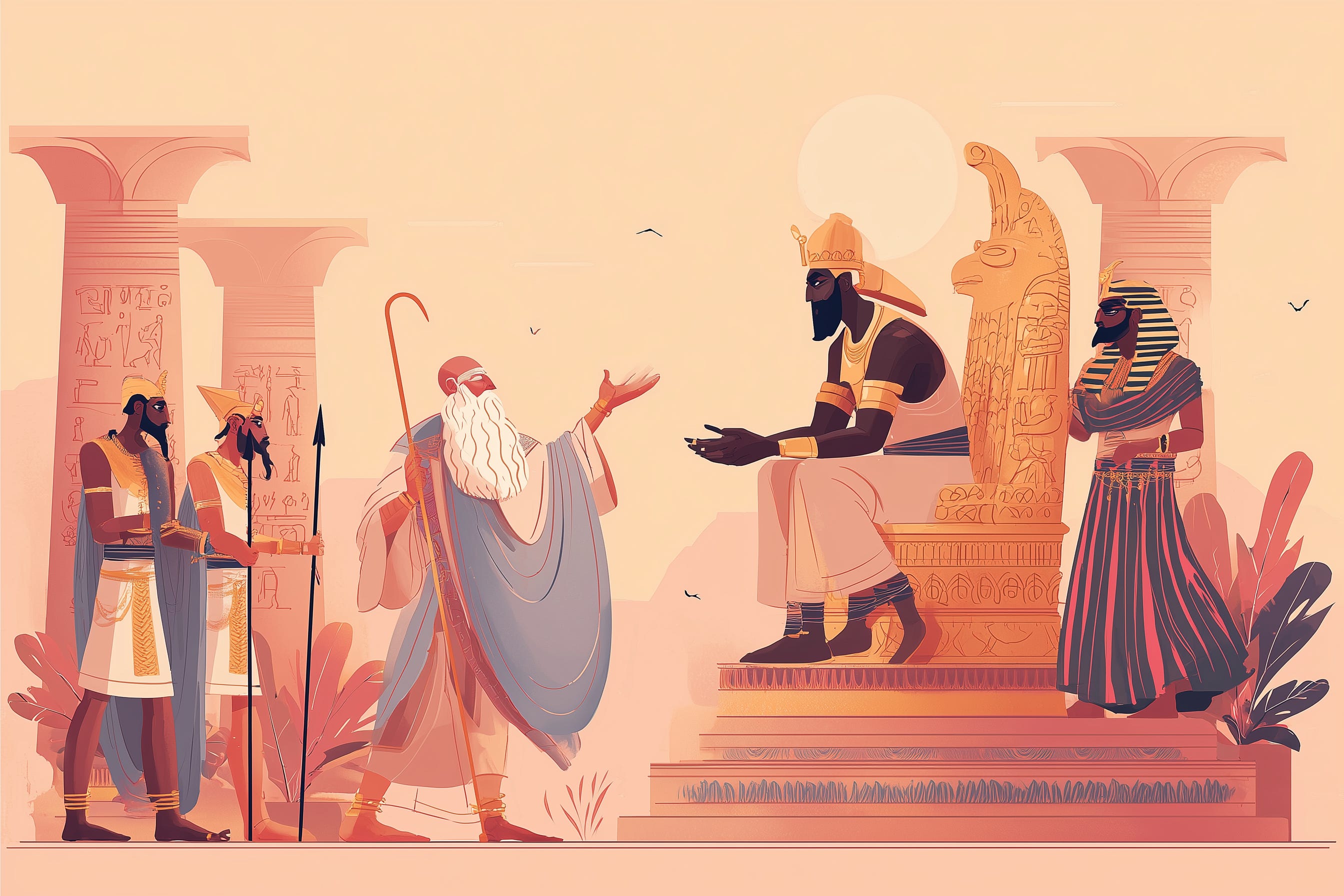
The wilderness still clung to Israel when the word of the Lord came to Moses. Pharaoh sat on a throne of stone, surrounded by the machinery of empire, and Egypt’s gods loomed in the imagination of the nations as powers to be feared, appeased, and served. Their temples promised favor through ritual, sacrifice, and control. But the God who spoke from the burning bush did not introduce Himself as one needy among the gods, nor as a distant force to be managed by human hands. He sent Moses with a declaration that struck at the very heart of empire: “Israel is my firstborn son… let my son go, that he may serve me” (Exodus 4:22–23). Before the plagues, before the sea split, before Sinai thundered, God named a people as His son.
What kind of God speaks this way?
What kind of King draws near not merely to command a people, but to claim them as His own?
And when Jesus later teaches His disciples to begin prayer with the words “Our Father,” what ancient lies does He overturn in a single breath?


The First Word That Destroys Orphan Spirituality
When Jesus teaches His disciples to pray, He does not begin with strategy, technique, or spiritual performance. He begins with relationship: “Our Father in heaven” (Matthew 6:9). That first word changes everything. Prayer does not begin with man climbing upward, but with God drawing near. It does not begin in anxiety, but in sonship. It does not begin with an orphan trying to earn bread, protection, or a name. It begins with a child speaking to the Father.
That word Father would not have sounded empty to the disciples. Jesus was not inventing a novel idea detached from Israel’s Scriptures. He was bringing to fullness a theme woven throughout the Old Testament. The Lord told Pharaoh, “Israel is my firstborn son” (Exodus 4:22). Moses later rebuked the covenant community by asking, “Is not he your Father, who created you?” (Deuteronomy 32:6). David was given covenant promises concerning his son with the language, “I will be to him a father, and he shall be to me a son” (2 Samuel 7:14; 1 Chronicles 17:13). The psalmist portrays the Lord as “a father of the fatherless” (Psalm 68:5) and later records the king crying, “You are my Father” (Psalm 89:26). Isaiah speaks from exile with aching hope: “You, O Lord, are our Father” and “We are the clay, and you are our potter” (Isaiah 63:16; 64:8). Jeremiah invokes the same covenant tenderness, and Malachi confronts Israel’s hypocrisy by asking what it means to call God Father while dishonoring His name (Jeremiah 3:4, 19; 31:9; Malachi 1:6; 2:10).
Even where God is not directly addressed as Father, His actions are unmistakably fatherly. He carried Israel “as a man carries his son” through the wilderness (Deuteronomy 1:31). He disciplined them “as a man disciplines his son” (Deuteronomy 8:5). Hosea records the Lord’s tender grief: “When Israel was a child, I loved him, and out of Egypt I called my son… I taught Ephraim to walk; I took them up by their arms” (Hosea 11:1–4). David says, “As a father shows compassion to his children, so the Lord shows compassion to those who fear him” (Psalm 103:13). Isaiah portrays God carrying His people from the womb to old age and comforting them as a mother comforts her child (Isaiah 46:3–4; 66:13). The Old Testament hums with covenant fatherhood.
By the time Jesus says, “Our Father,” He is not replacing the God of Israel with a softer deity. He is unveiling the deepest truth about the God who has always drawn near to His covenant people.
God Is Not Hungry for Human Appeasement
This matters because the nations around Israel imagined the gods very differently. In the pagan imagination, the gods were often volatile, needy, and capricious. Offerings were understood as a way to feed divine appetites, secure favorable outcomes, and avert unpredictable wrath. Worship was often driven by fear: have we done enough, offered enough, pleased the powers enough?
But the living God shatters that entire framework. In Psalm 50, the Lord exposes the absurdity of thinking He depends on human offerings the way idols supposedly do: “If I were hungry, I would not tell you, for the world and its fullness are mine” (Psalm 50:12). What a devastating blow to pagan religion. The God of Scripture is not sustained by sacrifice. He owns the cattle on a thousand hills. He is not nourished by human ritual. He is not manipulated by performance. He is not a deity humans must keep fed so that He will not lash out.
Biblical worship, then, is not divine appeasement. It is surrender. It is response. It is covenant communion. The Father is not in need. We are. He does not command worship because He lacks something, but because we do. We are creatures made for fellowship with Him, and apart from Him we starve ourselves in the wilderness.
This is one reason “Our Father” is so revolutionary. Jesus teaches us to begin prayer without superstition. We do not bring our words as bargaining chips. We do not perform to gain audience. We do not speak to an unstable force of weather, war, harvest, or fate. We come to the Father who already knows what we need before we ask Him. Prayer, then, is not the anxiety of slaves trying to survive an empire of gods. It is the confidence of children entering the presence of the Father.
Sonship, Not Slavery
To say “Our Father” is to begin from identity, not scramble for it. This is where the gospel tears through the lies of Babylon and the lies of the serpent alike. The world says, “Prove yourself.” Babylon says, “Make a name for yourself.” The flesh says, “Perform, strive, and build an identity no one can take away.” But the Father says, “You are Mine.”
This theme runs throughout Scripture and comes to fullness in Christ. At Jesus’ baptism, before His public ministry, before miracles, before sermons, before the cross, the Father declares, “This is my beloved Son, with whom I am well pleased” (Matthew 3:17). Immediately afterward, Satan attacks not first Jesus’ strength, but His identity: “If you are the Son of God…” (Matthew 4:3, 6). This is always the enemy’s strategy. If he can sever identity from the Father’s voice, he can pull people into striving, fear, and bondage.
But Jesus does not live from insecurity. He lives from sonship. And through Him, so do we. John writes, “To all who did receive him, who believed in his name, he gave the right to become children of God” (John 1:12). Paul says we have not received “the spirit of slavery to fall back into fear,” but “the Spirit of adoption as sons, by whom we cry, ‘Abba! Father!’” (Romans 8:15). He continues: “The Spirit himself bears witness with our spirit that we are children of God, and if children, then heirs” (Romans 8:16–17).
This is staggering. In Christ, prayer does not rise from slaves trembling in the courtyard. It rises from adopted sons and daughters who have been brought into the household. The gospel does not merely forgive lawbreakers. It adopts orphans. It does not merely erase debt. It confers family. The one who says “Our Father” is not trying to convince God to be near. In Christ, God has already drawn near and brought us near.
This should destroy orphan spirituality. Orphan spirituality hustles for security, provision, and affection. It lives with a constant ache of “not enough.” It cannot rest. It must outperform, outshine, and outlast because it has no settled home in the Father’s love. But Jesus teaches us to pray as children. Children ask. Children trust. Children rest under a name they did not create, cannot improve, nor can they seperate themselves from the reality of it.
The Father Gives Identity
In every age, Babylon offers counterfeit identity. At Babel, men said, “Let us make a name for ourselves” (Genesis 11:4). That is the eternal slogan of the world system. Build. Prove. Seize. Define. Name yourself before someone else names you. This is why every generation, ancient or modern, feels the pressure to manufacture identity out of achievement, sexuality, power, status, platforms, appearance, or tribe. But all self-made names eventually crack beneath the weight they were never designed to bear.
Jesus confronts that world with two words: “Our Father.” In those words, identity is received, not seized. A child does not generate his own lineage. He receives a family name. He receives belonging. He receives inheritance. He receives love not because he achieved it, but because he was brought into the household.
This is one of the deepest implications of the Lord’s Prayer. We do not begin prayer by announcing ourselves to God. We begin by being named by Him. Our confidence is not, “Look what I have built.” Our confidence is, “I belong to the Father through the Son.”
This is why the Fatherhood of God is not casual or sentimental. It is covenantal. It is redemptive. It is identity-forming. The Father names a people in Exodus before He frees them from Egypt. He names His beloved Son before Jesus enters the wilderness. He names us His children in Christ before we ever become fruitful in obedience. Obedience grows from identity, not the other way around.
Our Father Creates Family
Jesus does not teach us to say merely “My Father,” though that is gloriously true for each believer. He teaches us to say “Our Father.” From the first phrase of the prayer, individualism dies. Christianity is not a solo spirituality. The Father gathers a household.
This has enormous implications. If God is our Father, then the church is not a loose association of religious consumers. It is a family of adopted sons and daughters. Prayer itself becomes an act of covenant solidarity. When we say “our,” we are reminded that grace has made us kin. We come before God not as isolated spiritual freelancers, but as members of one redeemed people.
This reshapes everything. It reshapes forgiveness, because we are dealing not with strangers but with brothers and sisters under one Father. It reshapes generosity, because family shares burdens. It reshapes discipleship, because older siblings in the faith help younger ones grow in the household. It reshapes mission, because the Father is gathering children from every tribe and tongue. It reshapes church life, because the gathered people of God are not a crowd at a religious event but a covenant family at the Father’s table.
This is especially important in an age of fragmentation, consumerism, and loneliness. The world trains us to ask what a community can do for us. The Lord’s Prayer trains us to remember whose household we are in. The Father creates a people. The gospel is thus familial.
From Egypt to Christ
There is a beautiful line running from Exodus to the New Testament. In Exodus 4:22–23, Israel is called God’s firstborn son and is delivered out of bondage. In Hosea 11:1, the Lord says, “Out of Egypt I called my son.” Matthew later applies this to Jesus (Matthew 2:15), showing that Christ embodies Israel’s story and fulfills it. He is the true Son who succeeds where Israel failed.
This means our sonship is not abstract. It is anchored in union with Jesus. We are adopted because the true Son has brought us in. We are not naturally entitled to call God Father because of our morality, pedigree, or effort. We call Him Father because the Son has opened the way. His obedience, His death, and His resurrection secure our adoption.
So when we pray “Our Father,” we are praying in the wake of redemption. Israel’s firstborn-son language in Exodus pointed forward to a greater exodus in Christ. The Father is not merely the God who delivered one nation from one empire. He is the God who, through His Son, delivers His people from sin, Satan, and death and brings them into the liberty of beloved children.
Conclusion
When Jesus teaches us to say “Our Father,” He gives us more than a prayer formula. He gives us an entire world. He reveals the God who has always drawn near to His covenant people, the God who is not fed by human hands, the God who gives identity instead of demanding self-invention, the God who gathers a family instead of cultivating isolated strivers.
The first word of the Lord’s Prayer destroys orphan spirituality because it tells us who God is and who we are. He is Father. We are His children through Christ. That means prayer begins not in fear, but in belonging. It begins not in bargaining, but in covenant nearness. It begins not in Babylon’s pressure to make a name, but in the Father’s grace to give one.
The God who spoke over Israel, “My firstborn son,” now gathers sons and daughters in His beloved Son. The God who carried His people through the wilderness now teaches us to cry, “Abba, Father.” The God who once revealed fatherly tenderness in shadows and promises has now brought that revelation to fullness in Jesus Christ.
So let us come to our Father as Jesus taught us. Not as slaves. Not as orphans. Not as performers. But as children who are near because the father has come near to us.
Are you still living like an orphan—striving for a name, scrambling for security, and trying to earn what the Father freely gives in Christ? If so, pray this prayer:
Father, I come before You confessing how often I have lived as though I were an orphan. I have sought identity in things that cannot name me, security in things that cannot hold me, and approval in places that constantly move the goalposts. I have listened to the voice of Babylon telling me to make a name for myself, to prove myself, to build something impressive enough to matter. I have lived like a spiritual orphan, anxious and tired, hustling for what can only be received from You.
Forgive me. Thank You that through Jesus Christ I am not called to slavery but to sonship. Thank You that You are not distant, unpredictable, or hungry for my performance. You are the Father who draws near. You are the One who names Your children, carries them, disciplines them in love, and invites them to come boldly to You. Teach my heart to believe what my lips confess. Teach me to pray not as a stranger outside the door, but as a child in the household.
Lord Jesus, thank You for being the true Son who obeyed where I failed, who opened the way to the Father through Your death and resurrection, and who brought me near by grace. Holy Spirit, bear witness with my spirit that I am a child of God. Break the lie of orphan spirituality in me. Heal the places where I still strive, compare, fear, and perform. Root me in the Father’s love until obedience grows from belonging and peace grows from trust. And make me a faithful member of Your household, loving my brothers and sisters as fellow heirs of grace. In Jesus’ name, amen.
Bibliography
J. I. Packer, Knowing God
Sinclair B. Ferguson, Children of the Living God
Dane C. Ortlund, Gentle and Lowly
John Stott, The Cross of Christ
F. F. Bruce, The Epistle to the Galatians
Leon Morris, The Gospel According to Matthew
R. T. France, The Gospel of Matthew
D. A. Carson, Sermon on the Mount
Alec Motyer, The Prophecy of Isaiah
Christopher J. H. Wright, Knowing Jesus Through the Old Testament
Tremper Longman III and Raymond B. Dillard, An Introduction to the Old Testament
Edmund P. Clowney, The Church
Scripture References
Exodus 4:22–23, Matthew 6:9, Deuteronomy 32:6, 2 Samuel 7:14, 1 Chronicles 17:13, Psalm 68:5, Psalm 89:26, Isaiah 63:16, Isaiah 64:8, Jeremiah 3:4, Jeremiah 3:19, Jeremiah 31:9, Malachi 1:6, Malachi 2:10, Deuteronomy 1:31, Deuteronomy 8:5, Hosea 11:1–4, Psalm 103:13, Isaiah 46:3–4, Isaiah 66:13, Psalm 50:12, Matthew 3:17, Matthew 4:3, Matthew 4:6, John 1:12, Romans 8:15–17, Genesis 11:4, Matthew 6:9, Matthew 2:15