

The Grain Offering
How the Second Levitical Sacrifice Points to Trusting God as the Source of Provision

Morning light stretches across the Sea of Galilee as small boats begin landing near Capernaum. The crowd steps ashore eagerly, scanning the shoreline for Jesus. Some still carry the memory of yesterday’s meal—the weight of bread in their hands, the unexpected fullness in their stomachs, the astonishment of watching five loaves feed thousands.
They’d been hungry, and Jesus had fed them.
However, when they finally find Him, Jesus looks beyond their excitement and speaks directly to what is their true motivation. They are searching for Him, He says, not because they understood the sign, but because they ate the bread and were filled. Then He tells them not to labor merely for food that perishes, but for the food that endures to eternal life (John 6:26–27).
Then the crowd asks for another sign. After all, their ancestors ate manna in the wilderness. Could Jesus give them bread from heaven again?
Then Jesus says something no one standing there could have expected:
“I am the bread of life; whoever comes to me shall not hunger, and whoever believes in me shall never thirst” (John 6:35).
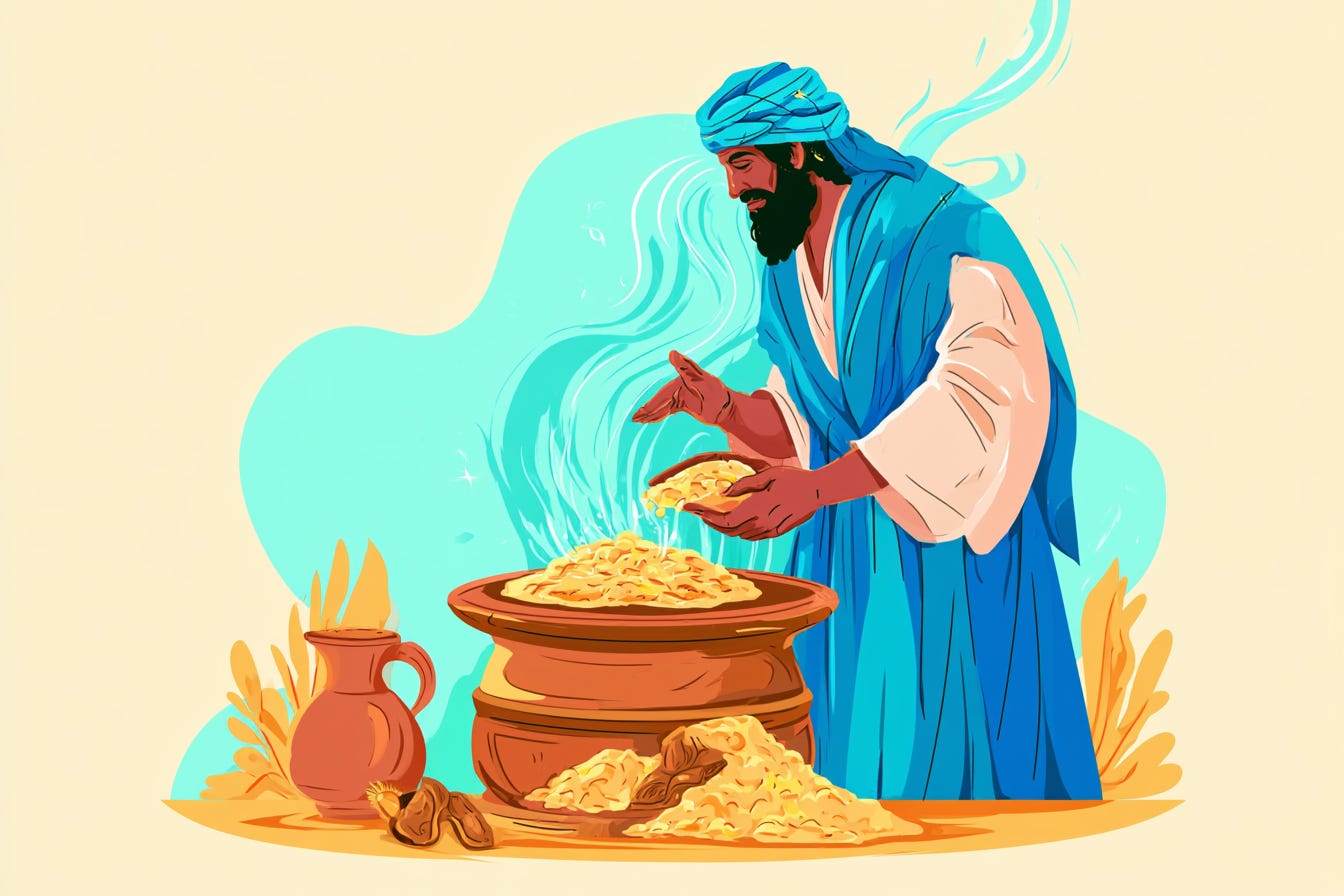
Behind those words lies a long biblical story of grain, provision, worship, and life. Long before Jesus fed the multitude, God had instructed Israel to bring fine flour, oil, frankincense, and salt to His altar. This offering contained no animal and required no shed blood. It came from the field, the millstone, the oven, and the labor of human hands. It represented food—the ordinary substance that sustained daily life—returned to the God who had first provided it.
But why did God ask for fine flour rather than unprocessed grain?
Why did the worshiper pour oil over it and place frankincense upon it?
Why were leaven and honey kept away from the altar while salt could never be omitted?
And how could this quiet offering of bread point toward Jesus, whose perfect humanity became an offering wholly pleasing to His Father?


What Was the Grain Offering?
Leviticus 2 introduces what many English translations call the “grain offering”. The Hebrew word minchah can describe a gift, tribute, or offering presented to someone of honor. In this setting, the grain offering was a voluntary act of worship that expressed gratitude to God for His provision and acknowledged that all sustenance ultimately comes from Him. It was not primarily for atonement, but for thanksgiving, devotion, and the consecration of everyday life to the Lord.
The Israelites were not required to bring the grain offering at a single fixed moment like Passover or the Day of Atonement. Instead, it was brought whenever they desired to honor the Lord with the fruit of their labor. It often accompanied other sacrifices, especially burnt offerings, and was regularly associated with the rhythms of Israel’s worship life—particularly the firstfruits of the harvest and daily offerings in the tabernacle and later the temple (Leviticus 2:1–10, 14–16; Numbers 28–29). In that sense, it was woven into the ongoing life of Israel’s worship rather than tied to one annual obligation.
The offering could take several forms. A person might bring uncooked fine flour mixed with oil and topped with frankincense. Another might bring unleavened cakes baked in an oven, wafers spread with oil, grain cooked on a griddle, or flour prepared in a pan. Someone bringing the first produce of the harvest could offer fresh heads of grain roasted in fire, crushed, and mixed with oil and frankincense (Leviticus 2:1–10, 14–16).
Despite the varying types of grain offerings that could be presented, a common thread wove through all the options.
There was grain, which came from God’s earth, human labor, which cultivated, harvested, ground, mixed, and prepared it., oil, which enriched the flour, frankincense, which rose as fragrance before God, and salt, which could never be omitted.
The worshiper brought the offering to the priests. The priest then took a handful of the flour and oil, together with all the frankincense, and burned this “memorial portion” on the altar. The remaining grain was reserved for Aaron and his sons (the Levites) as a most holy portion of the Lord’s offerings (Leviticus 2:2–3).
Unlike the burnt offering, the entire grain offering did not ascend in the flames. God received a representative portion, while the rest sustained those who served in His sanctuary. The offering rose toward heaven, yet it also became provision on earth for his workers in the temple.
It was not that God needed to be “fed” by his supplicants. What was understood by the Israelites was that all things came from God and they were returning the first fruits of their harvests of God’s provision back to him. Therefore, this was an expression of Trust that God would provide enough even though they sacrificed the best and choicest portion of what he provided back to Him the source.
Why Did God Require Fine Flour?
The worshiper couldn’t simply throw a handful of rough grain onto the altar. In most forms of the offering, God required fine flour.
Fine flour took time to produce. Grain had to be harvested, separated, crushed, ground, and sifted until the coarse pieces disappeared. The final product carried an even texture. No hard husk remained hidden inside it. No rough portion stood apart from the rest.
In Genesis, God commanded Adam and Eve to “subdue the earth”. This is likely the reason for the flour over raw grain requirement. It was understood that Israel would be generous to the nations and give freely to strangers and foreigners in their land. If God is the provider and He is trustworthy, then even after giving the choicest portion back to God and by being generous in giving freely to others, Israel would not ever lack.
Their security rested in His abundance. Their acceptance surrounded them in His presence (Genesis 1:26–28; 2:8–9, 15, 25).
After the fall, the nations spread out in the land and no longer balanced it according to God’s original design. Instead of giving back the first fruits, they kept the choicest for themselves. Instead of being generous, they adopted a scarcity mindset. Any flour the nations produced certainly would not be offered to the Creator and Source of the grain, and it would be hoarded and not given generously to those who needed it. The grain offering and specifically refined grain in the form of flour was a symbol to represent that Israel’s labor was to be put in subordination to the God the provider of the harvest.
What Did the Oil Reveal?
Yet, grain was not the only aspect of this offering that needed to be offered by the worshipper. It was also required for them to provide oil. Throughout Scripture, oil often accompanies consecration. Priests and kings were anointed with oil when God set them apart for service. The title Messiah itself means “Anointed One.” Oil could also bring richness, healing, light, and gladness.
For the Israelites, oil wasn’t an abstract symbol but a daily necessity drawn from the fruit of the olive press. Olive oil was used for cooking, preserving food, lighting lamps in homes and in the tabernacle, and even for medicinal purposes. To add oil to the grain offering was to take something already valuable and essential and pour it into the act of worship. It transformed dry flour into something closer to bread or cakes—food that was ready to be eaten—so the offering itself reflected the goodness and abundance of the land God had given them, a land described as flowing with “olive oil and honey” (Deuteronomy 8:8). In this sense, the oil represented not only consecration but also the worshiper’s acknowledgment that even the richness of daily life, the fruit of the olive press, and the best of agricultural provision ultimately came from God and was worthy of being returned to Him.
For us on the other side of Jesus’s resurrection and ascension, we can understand that the oil can represent Jesus as the bread of Life with the anointing of the Holy Spirit upon him. Bread (grain) with the Anointing Spirit (oil). Put together you can see the union of both:
The Spirit of the Sovereign LORD is upon me, for the LORD has anointed me to bring good news to the poor. He has sent me to comfort the brokenhearted and to proclaim that captives will be released and prisoners will be freed. ~ Isaiah 61:1
Jesus replied, “I am the bread of life. Whoever comes to me will never be hungry again. Whoever believes in me will never be thirsty. ~ John 6:35
Therefore, in Christ we see the product of God’s provision and the anointing of His Spirit together in one person. In this, Jesus modeled holy life for us as believers. We are from God, our labor is meant to bless the nations and this is made possible by the anointing of the Holy Spirit.
Why Was Frankincense Added?
The worshiper placed frankincense upon the grain offering. When the priest burned the memorial portion, all the frankincense went into the fire (Leviticus 2:1–2).
Frankincense produced a costly and distinctive aroma. As the offering burned, its fragrance rose from the altar. Leviticus repeatedly calls these altar offerings a pleasing aroma to the Lord.
Obviously, God is Spirit and does not possess human nostrils or depend upon pleasant smells. The language communicates divine pleasure and acceptance. The offering, presented according to God’s instruction, rose before Him as something welcomed.
Frankincense was not a common household spice in ancient Israel. It was a costly resin imported from distant regions, likely from Arabia or the Horn of Africa, carried along long and dangerous trade routes. Because of its rarity and expense, it was associated with wealth, honor, and sacred use. Ordinary families would not have used it in daily life. It was reserved for worship, royal courts, and special occasions that carried weight and significance.
In most cases, Israelites would not have been required to produce or harvest frankincense themselves. Instead, it would have been obtained through trade, meaning the worshiper would typically purchase or acquire it as part of preparing the offering. This detail itself reinforces the nature of the grain offering: even the “extras” of worship were not casual or incidental, but drawn from resources that required effort, cost, and intentional preparation.
When burned, frankincense released a thick, sweet, and distinctive aroma that filled the air and lingered. In a world without artificial fragrances, this rising smoke would have been immediately recognizable. It marked the moment as set apart. In Israel’s worship, that rising fragrance became a sensory sign that the offering had been fully given over to God.
For the Israelites, then, frankincense carried at least three overlapping meanings. First, it signified costliness—this was not an offering of convenience but of real sacrifice, something valuable surrendered to God. Second, it signified honor—just as incense might be used in the presence of a king, so its use in worship acknowledged the Lord’s royal majesty. Third, it signified consecration—the rising smoke visually expressed that the gift had been lifted from ordinary use into sacred space, belonging wholly to God.
Here again, Jesus fulfills the pattern at a depth no Israelite worshiper ever could as His entire life rose before the Father as fragrant worship. Every conversation, journey, meal, prayer, act of compassion, and unseen decision belonged to His devotion.
Jesus said, “I always do the things that are pleasing to him” (John 8:29).
The Way of Jesus in His obedience to the Father was costly to Him. It cost him his very life. In everything Jesus did and said it gave honor and deference to the father. In his words and deeds Jesus set himself apart from the world and consecrated himself unto a life of holiness in service to God.
As believers and followers of Christ, we are called to Jesus’s Way which should be costly for us, give honor to God and reflect a life of set-apartness as we consecrate ourselves for the watching world.
Why Were Leaven and Honey Kept from the Altar?
God prohibited the worshiper from burning leaven or honey as an offering made by fire. They could be presented among the firstfruits, but they were not to ascend from the altar (Leviticus 2:11–12).
Both leaven and honey could ferment. At the very least, the altar received nothing that swelled, soured, or changed through fermentation. The offering placed into the fire had to remain free from those agents.
In the New Testament, leaven is revealed to be a fitting picture of influence that spreads through a larger whole. Jesus warns His disciples about the leaven of the Pharisees—the hypocrisy that works beneath religious appearance (Luke 12:1). Paul also uses leaven as a picture of corrupting influence within a community (1 Corinthians 5:6–8).
This clearly points to keeping our sin from the first fruits that we offer back to God. That makes the absence of leaven especially meaningful as we look toward Jesus.
Satan tempted Him to throw Himself from the Temple and force a public display of angelic rescue. Jesus refused (Matthew 4:5–7). After feeding the multitude, the crowd tried to take Him and make Him king by force. Jesus withdrew (John 6:15). His brothers urged Him to make Himself publicly known, but Jesus refused to let human pressure control the Father’s timing (John 7:3–8).
Nor did Jesus sweeten truth to keep people comfortable. His words carried compassion, but never flattery. He welcomed sinners while calling them away from sin. He touched lepers, ate with tax collectors, defended the vulnerable, and spoke hope to the ashamed. Yet He also confronted hypocrisy, exposed unbelief, and allowed disappointed hearers to walk away.
Sin is autonomy from God’s design and Law. Thus, our offerings to God cannot be rooted in our own desires and ambitions. We can’t serve the Lord and our own desires. These are incompatible. Sometimes we confuse pleasing God with appearing pleasant to everyone. We avoid truth because we fear rejection. Or we use polished spiritual language to hide resentment, pride, addiction, or unbelief. The outside smells sweet, perhaps, but fermentation has already begun within.
The Salt That Could Not Be Omitted
Although leaven and honey could not enter the altar fire, salt was required for every grain offering.
“You shall season all your grain offerings with salt,” God commanded. “You shall not let the salt of the covenant with your God be missing from your grain offering; with all your offerings you shall offer salt” (Leviticus 2:13).
Salt preserved food and resisted decay. It seasoned what might otherwise remain bland. Because salt endured, it became associated with covenant permanence and faithfulness.
The grain offering therefore carried a reminder: Israel’s worship belonged within a covenant relationship. This was not a casual gift dropped at the entrance of the sanctuary. The worshiper approached the God who had delivered Israel, bound Himself to His people, and called them to faithful obedience.
Yet Israel repeatedly failed to preserve covenant faithfulness. Their worship could continue outwardly while their hearts wandered toward idols. They brought offerings while neglecting justice. They honored God with their lips while their hearts remained far from Him (Isaiah 1:11–17; 29:13).
Jesus, however, embodies covenant faithfulness without decay.
He does not abandon the Father’s will when obedience becomes difficult. He remains faithful when hungry, misunderstood, rejected, and threatened. He remains the beloved Son in the wilderness, the crowded village, the hostile synagogue, the lonely garden, and the place of suffering. If we are to be followers of Jesus, we too must persevere in faithfulness despite the circumstances we encounter.
The Bread of Life
The grain offering should compel us to loosen our grip. The worshiper takes bread—the most ordinary symbol of survival—and returns it to God, confessing that security is not found in stored grain but in the God who sends rain and sustains life. Jesus embodies this trust perfectly. He receives bread, gives thanks, breaks it, and multiplies it for others. He teaches us to ask for daily bread rather than build our lives on anxious accumulation (Matthew 6:11, 25–34). A secure identity can give; an insecure one must keep grasping.
This is why Jesus can say, “I am the bread of life.” Bread must be received, not merely observed. In the grain offering, bread is returned to God; in the gospel, God gives the true Bread to us. Jesus is both the perfect human life offered to the Father and the life given to the world. Through faith, we receive Him—not as an idea, but as our very life.
The crowd in John 6 wanted another temporary meal, but Jesus offered Himself as the Bread from heaven who gives eternal life (John 6:32–35, 48–51). This actually reveals Jesus’s humanity and divinity perfectly intwined He entered our condition fully—hunger, weariness, sorrow, temptation, and pain—yet without sin. Hebrews says He sympathizes with our weakness because He has been tempted as we are (Hebrews 4:15). Still, nothing in Him turned from trust into rebellion. No hunger became distrust, no suffering became hatred, no recognition became pride. His life remained the pure offering humanity was always meant to be.
Do not make the fatal mistake of concluding that we must be perfect in order to please God or receive His salvation. Seeing Jesus’ perfection, we might assume the Christian life is about grinding ourselves into acceptable form for God. But the gospel is not about self-improvement; it is about union with Christ. Our acceptance rests on Him, not on how finely we refine ourselves. Our security rests in the Father, not in what we can store or achieve. Our significance rests in God’s calling, not in public recognition (Ephesians 2:10). We do not become children of God through performance—we serve because we already are.
Don’t conclude then that obedience is optional God still shapes His people, often through ordinary places like work, family, conflict, and waiting. But correction is not rejection. The One who forms us is for us, not against us; He prepares us for holy use. Because we belong to Him, correction doesn’t threaten our identity, it is the evidence of sonship.
This is why Paul can speak of his life as a drink offering poured out in joy (Philippians 2:17). His labor, suffering, and service are not wasted—they become worship. In the same way, the grain offering expands into our daily lives. Ordinary faithfulness—working honestly, serving quietly, loving patiently, resisting temptation, giving generously—can all rise before God. Not because ordinary things become sacred through effort, but because a life united to Christ already belongs to God.
But we must realize that Jesus is the grain offering. The Bread of life who was anointed with the Holy Spirit who rose as a pleasing offering to God on our behalf. We are to model our lives in that pattern, but we can never be the offering that Jesus provided for us. In Christ, the Bread of Life has already been given, received, and shared. Now our lives become the echo of that gift—bread returned in gratitude, and bread received in grace.
Conclusion
The grain offering appears quiet beside the blood and fire of the other sacrifices. It comes from the field rather than the flock. It carries no cry of an animal and spills no blood. Instead, it brings fine flour, oil, frankincense, and salt—the substance of ordinary life placed before God.
Yet within that quiet offering, the shape of Jesus begins to appear.
He is the fine flour of perfect humanity, tested without sin. He is the Anointed One who lives in the fullness of the Spirit. His devotion rises like frankincense, pleasing to the Father. No leaven of hypocrisy swells within Him. No artificial sweetness replaces truth. The salt of covenant faithfulness remains present through every moment of His life. And as the Bread of Life, He becomes God’s provision for a starving world.
Jesus does not merely teach us how to worship. His whole life is worship. Every word, every act of obedience, every refusal of temptation, every prayer, every healing, and every step toward the Father’s will belongs to one complete offering.
We bring God the first fruits of the harvest that ultimately comes from Him. He is the source of all provision and we should honor Him with the first and choicest fruits of our lives as recognition of His abundant provision. We can trust that He will always provide and thus be generous to the world with His provision.
Through Jesus, we learn that worship flows from identity. The Father names the Son beloved, and the Son offers Himself in love. In Christ, the Father receives us as His children, and we begin offering our own lives—not to earn a name, but because He has given us one.
So bring Him the field and the flour. Bring Him the ordinary work and the hidden obedience. Bring Him the part of life no one applauds. Let the Spirit mix grace into your labor. Let prayer rise like frankincense. Let truth remove what is false. Let covenant faithfulness season every relationship and responsibility.
The God who provides the grain is worthy to receive our trust, our labor and our worship.
Are you struggling to trust God with the very provision He has already given you in abundance—clinging tightly to what He has placed in your hands, as though your security depends on your control rather than His faithfulness? Or are you trying to shape your life through performance instead of being conformed to Christ, the true Grain Offering, whose perfect life has already been offered to the Father on your behalf? If so, pray this:
Father, I come before You with open hands, though I confess how often they have been clenched. Every good thing in my life—every breath, every provision, every opportunity, every relationship—has come from Your generous hand. Yet I have often lived as though what You have given me must be secured, protected, and controlled by my own effort. I have struggled to trust You with abundance, fearing that if I release what You have provided, I will lack what I need. Forgive me for treating Your gifts as if they were fragile instead of trusting You as the faithful Giver.
Lord Jesus, You are the true Grain Offering—Your life wholly given, perfectly yielded, and fully pleasing to the Father on my behalf. You are the Bread of Life who did not grasp, hoard, or strive in fear, but lived in perfect trust and obedience. Thank You that I do not have to become my own offering, nor secure my own acceptance. I receive You again as the One who has already been offered for me, and in whom I am already accepted.
Holy Spirit, teach me to live in the freedom of trust. Where I cling in fear, loosen my grip. Where I hoard what God has given, open my hands in generosity. Where I strive to secure what has already been provided, anchor me in the sufficiency of Christ. Conform my life to Jesus—not in anxious imitation, but in Spirit-formed transformation.
Father, take all that You have entrusted to me and teach me to steward it in trust. Let my work, my resources, my time, and my relationships become expressions of confidence in Your goodness rather than attempts to secure my own future. Free me from scarcity thinking and root me deeply in the abundance of Your provision.
I belong to You. Everything I have comes from You. And in Christ, everything I need has already been given. So I rest in You, and I offer my life back to You with gratitude and trust. In Jesus’ name, amen.
Bibliography
Andrew A. Bonar, A Commentary on Leviticus.
Sinclair B. Ferguson, The Whole Christ.
John E. Hartley, Leviticus, Word Biblical Commentary.
R. K. Harrison, Leviticus: An Introduction and Commentary, Tyndale Old Testament Commentaries.
L. Michael Morales, Who Shall Ascend the Mountain of the Lord? A Biblical Theology of the Book of Leviticus.
Vern S. Poythress, The Shadow of Christ in the Law of Moses.
Allen P. Ross, Holiness to the Lord: A Guide to the Exposition of the Book of Leviticus.
Jay Sklar, Leviticus: An Introduction and Commentary, Tyndale Old Testament Commentaries.
Derek Tidball, The Message of Leviticus: Free to Be Holy.
Gordon J. Wenham, The Book of Leviticus, New International Commentary on the Old Testament.
Rankin Wilbourne, Union with Christ: The Way to Know and Enjoy God.
Scripture References
John 6:26–27, John 6:35, Leviticus 2:1–10, Leviticus 2:14–16, Leviticus 2:2–3, Genesis 1:26–28, Genesis 2:8–9, Genesis 2:15, Genesis 2:25, Hebrews 4:15, Deuteronomy 8:3, Matthew 4:1–4, Luke 3:21–22, Luke 4:1, Luke 4:18, Leviticus 2:1–2, John 8:29, Leviticus 2:11–12, Luke 12:1, 1 Corinthians 5:6–8, Matthew 4:5–7, John 6:15, John 7:3–8, Psalm 51:6, Leviticus 2:13, Isaiah 1:11–17, Isaiah 29:13, Leviticus 2:2–3, Leviticus 2:9–10, Matthew 6:11, Matthew 6:25–34, John 6:32–35, John 6:48–51, Hebrews 4:15, Ephesians 2:10, Philippians 2:17