


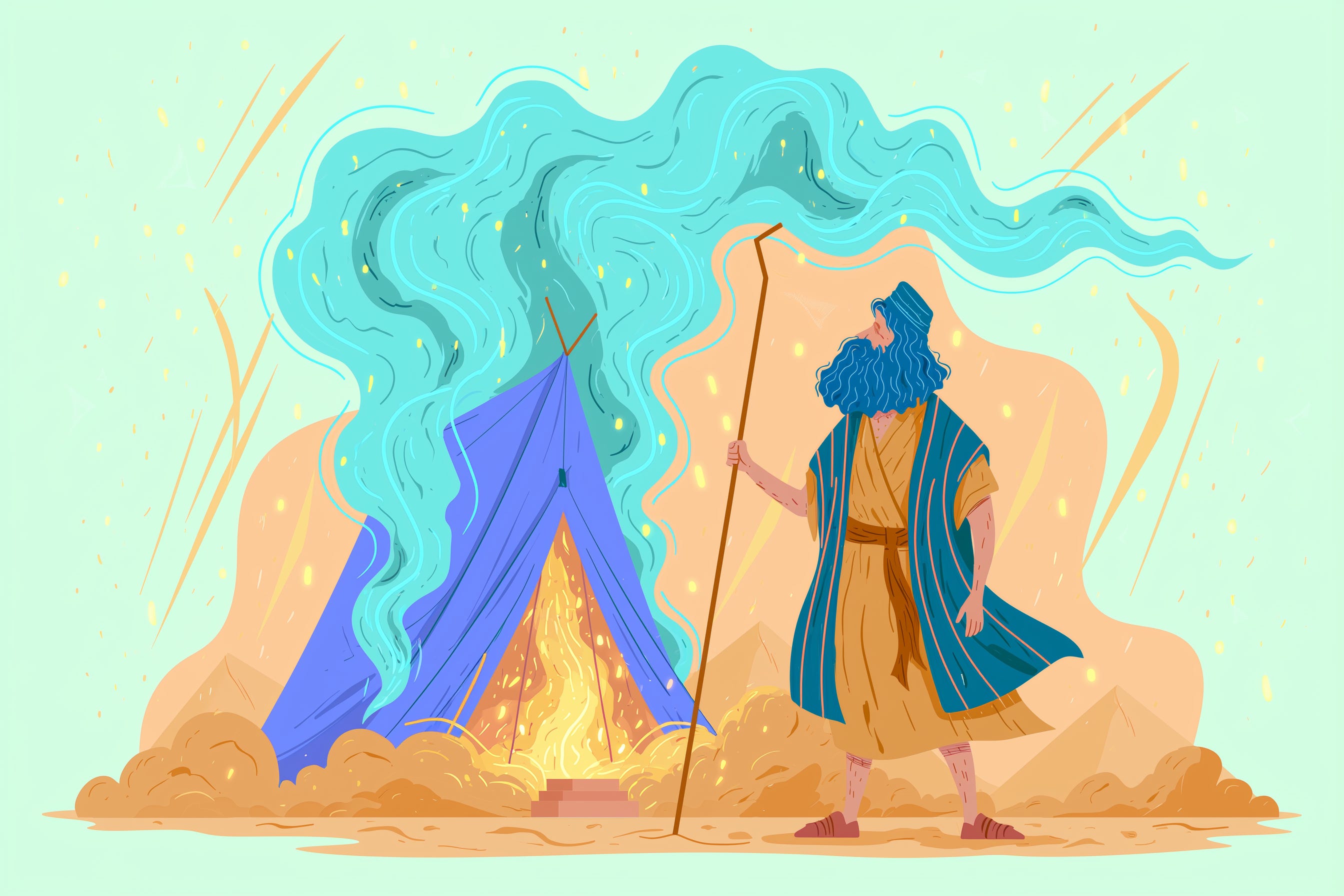
The wind through the wilderness howls with a eerie quality at the moment the finishing touches are put on the tabernacle. For months, Israel’s craftsmen have hammered gold, cut acacia wood, stretched linen, spun blue and scarlet thread, and shaped bronze beneath the wilderness sun. Their fingers are probably sore by now, and their shoulders may ache from lifting and carrying the materials. Fine dust clings to their hair, settles into the folds of their clothing, and drifts through the camp. Still, piece by piece, the place God described to Moses has taken shape.
The Israelites have faced adversity beyond belief since their rescue from Egypt. They have seen God do mighty things. He has parted seas and provided food. The plagues of Egypt they witnessed showed the God of Israel to be mightier than the gods of Egypt. What’s more, He has been present with them throughout their journey. Now, Yahweh wants to live with them. He will not be like the gods of the nations, their supplicants must strive to reach them and posture for their attention and favor. Yahweh is not like the other gods also in that He is not the god of a mere region. He is the God over all. The tabernacle is an expression of these wonders.
What’s more, the tabernacle was a way back into what had been lost. Adam and Eve had sinned in the garden and they had been separated from God because of their sin. The Tabernacle was an entryway back into the place where heaven and earth overlapped.
Its linen walls rise from the desert floor like a patch of purity planted in the dust. Inside the courtyard, the bronze altar waits. Beyond the first curtain, the golden lampstand burns and casts warm light across walls embroidered with cherubim, while the scent of incense hangs in the air. Farther in, behind the heavy veil, the ark rests beneath the outstretched wings of golden cherubim.
Then, the moment arrives. The glory of the Lord, the God of Israel descends upon the tabernacle. The very presence of the Lord is tabernacling with them. They have not gone to where He was, He has come to where they are. The glory of the LORD rushes into the tent and fills it so completely that Moses cannot enter (Exodus 40:34–35). Smoke-like splendor seems to press into every part of the sanctuary, and the very air appears heavy with God’s presence.
God’s anointed Moses however in the closing of Exodus stands outside the threshold. It is only in the first few lines of Leviticus that we see God interact with him.
“The LORD called Moses and spoke to him from the tent of meeting”
~ Leviticus 1:1
Of all people, why wouldn’t God allow Moses inside the tent?
That opening may tell us far more about Leviticus than we usually realize. Many people see the book as a dull heap of ancient regulations. They begin reading, encounter a couple of chapters about animals, blood, priests, and skin conditions, and quietly return to Psalms. I too have skipped over Leviticus (and numbers) when reading through scripture. Leviticus probably isn’t the first book most of us reach for when we feel tired, anxious, or in need of encouragement.
At first glance, the book can seem distant from ordinary Christian life. Most of us are not bringing bulls to an altar, inspecting homes for ritual impurity, sewing priestly garments, or burning incense inside a tent. The world of Leviticus looks very strange to the modern western ear.
But what if there is more to Leviticus than we realize?
What if the patterns and symbols in it’s text speak to a great mystery that God was preparing for the world. A way for us to see through the veil into the heart of God and His plans for His image-bearers?


The God who wanted to live with His people
Before the tabernacle was constructed, the Lord told the people of Israel why ti was necessary.
“Let them make me a sanctuary, that I may dwell in their midst” (Exodus 25:8).
The purpose was simple: God wanted to dwell among His people.
We hear language like that so often in church that it can lose its force. Yet the claim is astonishing. The God who formed the sun, moon, sea, and stars chose to establish His dwelling in the middle of a camp filled with former slaves. The One whom the heavens cannot contain descended into the dust, noise, conflict, meals, children, animals, and daily routines of human life. Why? Because He wanted to restore what had been lost. He wanted to redeem the division that had started at the Fall in the garden. He was setting in motion the pattern of approach. That is: Him approaching us. God drawing near.
This speaks to unimaginable grace. It speaks to a God who loves His creation so much that despite their rejection of Him, He draws near to them.
The camp of Israel around the tabernacle, is one important pattern. Every tribe arranged its tents around the tabernacle. When the cloud lifted, Israel packed up and moved. When the cloud settled, Israel stopped. Their journey, worship, community, and sense of direction revolved around God’s presence. What most people don’t realize is the pattern of the camp. The center of the camp branched outwards in 4 direction from he center. This forms the shape of a cross.
This carries us back to the themes explored in our Creation Awaits Identity series. Humanity was designed for communion with God. Adam and Eve did not search for a distant deity hidden beyond the stars. They walked with their Creator, heard His voice, and lived within the atmosphere of His presence.
From Him, they received acceptance. His provision gave them security, while His calling gave them significance. They did not invent an identity and then ask God to approve it. They received their identity from the One who made them.
God was not forcing Israel to pass tests in order to gain closeness to God. They were already near Him. The tests that follow were to purify them and strengthen their character so they would become the holy people of God. If we get this in reverse, it changes the nature of God and His character. He is seen not as who He is, the God whose grace and love surpass our failures, and we see Him as a tyrant who must be appeased in order for Him to draw near. The former is the Truth. The latter is a lie.
The Tabernacle as an Echo of Eden
The tabernacle was more than a place of worship. It’s design echoed the garden humanity had lost.
Cherubim appeared on the veil that guarded the Most Holy Place, much like the cherubim who guarded Eden’s entrance. The lampstand stretched out golden branches like a tree glowing within sacred space. Flowers, fruit, precious metals, fragrant oil, and carved beauty filled the sanctuary. Meanwhile, the entrance faced east, while God’s presence rested beyond a guarded boundary.
The parallels are pretty clear: it was a small echo of Eden standing in the middle of a wilderness.
The craftsmen did not add these details simply because the room needed decoration. God told Moses to build everything according to the pattern shown on the mountain (Exodus 25:9). Hebrews later says the priests served in “a copy and shadow of the heavenly things” (Hebrews 8:5). Thus, the tabernacle represented a place where heaven and earth overlapped just like Eden.
The tabernacle therefore gave Israel a small, earthly picture of a larger reality. God wanted to dwell with humanity, and humanity had been created for His presence. Sin, however, made unguarded access impossible.
That tension runs through the whole Bible. God comes near, though He remains holy. Humanity longs for His presence, though we also hide from it. We hunger for the acceptance, significance, and security that once flowed naturally from communion with God, yet we reach for counterfeits.
We may seek acceptance through the opinions of other people. We can seek security by controlling everything within reach. We may chase significance through performance, status, ministry, career, possessions, politics, or public recognition.
Most of us have probably tried all three in one form or another. After all that effort, we may still feel homeless inside. The next success promises relief, but the soul remains hungry for the God who made it.
Leviticus thus is a window into this reality. Humanity cannot heal its separation from God by wandering back into His presence on its own terms. We cannot make our way back to God through our own human effort. It doesn’t matter how pious we are or how well we perform.
God Himself must open the way.
Any path we invented would probably repeat the first sin. We would still be deciding for ourselves how God should be approached.
The Three Parts of the Pattern
God established three overlapping parts within Israel’s approach to Him: the tabernacle, the priesthood, and the offerings.
Later essays in this series will examine the individual offerings in detail, so we will resist the urge to unpack them here. For now, we need to step back and see the wider picture.
It is tempting to jump ahead to Jesus. We will get there. First, however, we need to understand the pattern God gave.
Each part answered a different side of the same problem.
The Tabernacle: God Made a Place for His Presence
The tabernacle carved out sacred space within the camp. Its outer court, Holy Place, and Most Holy Place led toward the center of God’s manifested presence. Each curtain and boundary taught Israel that God had truly come near, though approach remained ordered.
This was because of the problem of sin. Even though God had come near, to be corrupted by sin and to be in His presence was a death sentence. This is because God is without sin. He is perfectly holy. To bring evil into His presence is for that evil to be destroyed. So God placed concentric boundaries so that nothing with sin could enter into the holy of holies in the tabernacle. This was for the protection of those who came near to His presence.
God would make a better way for us to remain in His presence later, but let’s not get ahead of ourselves.
The Priesthood: God Appointed Mediators
The priesthood taught Israel that sinful people needed mediators. Priests stood before God on behalf of the people, and they stood before the people on behalf of God. They maintained the sanctuary, offered sacrifices, taught God’s instruction, and guarded the distinction between what was holy and what was common.
The high priest even carried the names of Israel’s tribes upon his garments. In a symbolic sense, he carried the people with him whenever he entered sacred space.
That image has always struck me. The priest did not enter as a private spiritual celebrity. He was the living representative of the people of Israel. When the priest entered, so did all of Israel.
This is not as to say that the priests possessed greater human worth. They served because God appointed them, not because they had achieved spiritual superiority. Their responsibility could become dangerous whenever they treated God’s holiness lightly.
The priesthood revealed something humanity couldn’t avoid: someone had to stand between the holiness of God and the uncleanness of the people. Someone had to represent them, carry blood into sacred space, and bear their names before God.
Israel’s priests remained imperfect, however. They needed cleansing too. They offered sacrifices for their own sins, grew weak, aged, died, and passed their ministry to someone else.
The priesthood helped Israel, though it also awakened expectation. A greater Priest still had to come.
What good, after all, is a mediator who still needs another mediator?
The Offerings: God Supplied the Way
The offerings gave Israel a vocabulary for approaching God. Through them, God addressed worship, consecration, fellowship, guilt, sin, cleansing, forgiveness, and restoration. Each offering revealed something about the damage sin causes and something about the mercy of the God who supplied the remedy.
The worshiper couldn’t arrive empty-handed and demand access. There had to be a sacrifice for the atonement of sin. A blood price. A penalty had to fall on something for sin. So, God ordained a substitution.
It is important to note that God is making the way for us. This is not an arbitrary set of rules to follow for the sake of obedience. This is a loving design of a process that helped Israel to deal with the separation that we as humans had ushered into the world. God made a way. Conversely, God could have ignored our sin and NOT given Israel a way to restore a relationship with Him. He could just let sin run rampant. So, why did He chose this set of rules and practices? It is for the simple reason that sin hurts us. When we sin against someone it hurts them and God is so loving and gracious that He wishes for us to stop hurting.
The sacrificial system did not portray humanity building a ladder to heaven through religious effort. Instead, it shows an amazing God opening a path through grace for us to be restored to relationship with Him.
A brief explanation of holiness
When people hear the word holy, they may picture God withdrawing from humanity in disgust. They imagine Him cold, distant, and irritated by anyone who gets too close.
Some of us may have grown up with that picture of God or still see God as this distant and disapproving deity.
The word ‘holy’ means “set apart.” Other ways of saying set-apart are: distinct, different, unique, even weird.
When God existed in eternity before humanity was ever created, he existed as a distinct, unique entity unlike any other. We tend to see holiness merely as piety or spiritual cleanliness. It is, but that doesn’t truly speak to the heart of why God wants us to be holy or what holiness looks like.
Leviticus records the Lord saying, “You shall be holy, for I the LORD your God am holy” (Leviticus 19:2).
This speaks to representation. God wishes for us to be like Him so that the world will know that we are His. This is a clear reference to Genesis 1:27. We were designed to be image-bearers of God. As we discussed in our Identity series, this means that as idols of the living God, when people look at use, they are supposed to see a representation of the God who created us. When we sin, they see a distorted image. God calls us to be holy so that we can portray the true image of our design to the world so that all the world may know that we are His and that His way is a better way.
A lie is a lie even if everyone believes it and the truth is the truth even if no one does. The truth stands in defense of itself. When we adopt the design of our Creator, it naturally works because it was the way is way designed to be. That way reflects the creator who designed it. It bears all the fruit of the Spirit of God who tabernacles with us.
But the fruit of the Spirit is love, joy, peace, forbearance, kindness, goodness, faithfulness, gentleness and self-control. Against such things there is no law.
~ Galatians 5:22-23
When we, as God’s people walk in holiness, these are the fruit of our walk. But this walk happens when we abide in the God who is with us, not by scrambling for holiness to receive God.
A Shadow of things to Come
Hebrews describes the tabernacle as “a copy and shadow of the heavenly things” (Hebrews 8:5).
The tabernacle, priesthood, and offerings thus are a shadow. A shadow is real, though it is not the solid object that casts it. It sketches an outline, reveals form, and announces that something greater stands near even when we cannot yet see the whole. The tabernacle system served real purposes within God’s covenant with Israel, while also tracing the form of redemption before the fullness arrived.
The tabernacle declared that God would dwell with humanity. The priesthood declared that humanity needed a mediator. The altar declared that sin brings death and that approach requires atonement. The washings announced that defilement must be cleansed, while the veil showed that the way into God’s presence remained guarded. Blood declared that life must be given.
The entire system leaned forward toward someone Israel had not yet seen.
You can almost feel the anticipation building.
Then the Word became flesh and “dwelt among us” [tabernacled] (John 1:14). Translation added.
John’s language deliberately recalls the tabernacle. We might say the Word “tabernacled” among us. John is calling attention to the reality we spoke about earlier. We didn’t need to seek God, He came to us.
In Jesus, God’s presence walked through dusty villages, touched lepers, ate with sinners, forgave the guilty, and called frightened, ordinary people to follow. Jesus even spoke of His own body as the true temple (John 2:19–21). To repeat this pattern, Jesus, the rabbi, also sought out his students even though traditionally students sought out rabbis.
The pattern had become a Person.
This may be where Leviticus stops feeling remote. The sanctuary, priesthood, and sacrifices all begin pointing toward Someone we know. What’s more, each offering of which there were five different types as described in Leviticus has patterns and symbols that point to Jesus as the awaited Messiah foretold by Moses and the prophets.
The Leviticus Series
In this series, we will explore each of the offerings as prescribed by God to Israel to combat the effects of the fallen world on humanity and how each of them points to Jesus. Here are the essays we will be releasing:
The Burnt Offering — A Life Fully Surrendered to God
The burnt offering was consumed entirely upon the altar, leaving nothing held back for the worshiper. In this essay, we will explore why God required an offering that was wholly given over to Him and what this reveals about surrender, obedience, and consecration. We will also consider what it means to place every part of life before God—our plans, desires, ambitions, bodies, and future—without reserving a private portion for ourselves. The burnt offering confronts the instinct to offer God only what feels convenient while keeping control of everything else. It raises a searching question: What does wholehearted devotion actually look like when nothing remains outside God’s claim?
The Grain Offering — The Perfect Life Offered in Worship
The grain offering was a bloodless gift made from fine flour, oil, and frankincense. Each element carried meaning, yet the offering also reflected the quiet faithfulness of ordinary life: seed planted, grain harvested, flour refined, and labor presented before God. In this essay, we will examine how the grain offering connects worship with purity, provision, gratitude, and devotion. We will consider how God shapes His people through pressure, refining, and patient formation, much as grain must be crushed and prepared before it becomes suitable for offering. The grain offering reminds us that worship is not limited to songs, gatherings, or dramatic moments. It may also rise from a life that God has carefully formed and willingly received.
The Peace Offering — Restored Fellowship Through Sacrifice
The peace offering was unique because it became a shared meal in the presence of God. Part of the offering was placed upon the altar, part belonged to the priest, and part was eaten by the worshiper and those gathered with him. In this essay, we will explore how this offering portrayed peace not merely as the absence of conflict, but as restored relationship, welcome, communion, and joy. We will examine why fellowship with God could never be treated as casual or assumed, and why peace required an appointed way of approach. The meal itself points to something deeply relational: God did not only call His people to stand at a distance in fear. He made a way for them to eat, rejoice, give thanks, and share fellowship before Him.
The Sin Offering — Cleansed from the Nature of Sin
The sin offering addressed more than individual acts of wrongdoing. It also dealt with the uncleanness and defilement that sin brought into the life of the worshiper and, at times, into the worshiping community itself. In this essay, we will examine why guilt required atonement and why defilement required cleansing. We will consider how sin reaches beyond isolated choices and corrupts the person, relationships, worship, and sacred space. The sin offering reveals that humanity’s problem cannot be solved through better intentions, stronger discipline, or outward reform alone. Something deeper must be addressed. God must cleanse what sin has polluted and restore those who can no longer make themselves clean.
The Guilt Offering — Restoring What Sin Has Broken
The guilt offering, also called the trespass offering, dealt with wrongs that created real loss, damage, or debt. Forgiveness did not erase the responsibility to repair what had been harmed. The worshiper was required to make restitution and add further compensation before bringing the offering. In this essay, we will explore how sin is never merely private, even when people attempt to hide it. It harms relationships, violates trust, takes what does not belong to us, and leaves brokenness behind. The guilt offering teaches that repentance involves more than feeling sorrow or admitting fault. Where possible, it also moves toward repair. We will consider what biblical restitution reveals about justice, responsibility, forgiveness, and the costly work of restoring what sin has broken.
Conclusion
Exodus ends with Moses standing outside the tabernacle while the glory of God fills it. Leviticus begins with God calling from within that glory and explaining how His people may approach.
That movement captures the heart of the scroll.
Leviticus is not a mound of meaningless religious rituals left behind by a primitive age. It reveals holiness, sin, grace, mediation, worship, and restored communion. The tabernacle places God’s presence among His people. The priesthood reveals the need for a mediator, while the offerings show that God Himself provided a way to draw near.
Together, they form shadows of the redemption fulfilled in Jesus Christ.
Humanity was designed for God’s presence. Sin drove us into hiding and fractured the identity we received from Him. God did not leave us east of Eden.
He moved toward us, established the pattern, entered our world, and opened the way through His Son.
We will explore in this essay series each offering and how they point to Jesus. We will see our separation from God, how we become new creations and God tabernacles with us closer than we deserve.
Are you trying to approach God through your morality, knowledge, religious activity, or performance? Have you believed that you needed to perform your way into God’s presence? If so, pray this:
Father, I come before You knowing that You are holy, though I’ve often treated Your presence too casually. At other times, I’ve hidden from You because I believed my sin placed me beyond Your mercy. I confess that I’ve tried to approach You on my own terms. I’ve trusted my behavior, compared myself with other people, excused what Your Word calls sin, and tried to build an identity apart from Your voice. Forgive me for choosing autonomy when You created me for communion.
Thank You for calling me while I was still outside. Thank You for revealing the pattern of redemption and then fulfilling it through Jesus Christ. I couldn’t remove the barrier, cleanse my own heart, or create a path into Your presence. Jesus came near, bore my sin, became my Mediator, and opened the way I could never open for myself.
Lord Jesus, I place my confidence in You rather than in my performance. Teach me to draw near with reverence but without terror, with humility but without shame, and with confidence but without presumption. Let Your finished work quiet the voice that says I must earn acceptance. Let Your presence become my security when life feels unstable, and let Your calling become my significance whenever I feel tempted to measure my worth through success, influence, approval, or recognition.
Holy Spirit, make my life a dwelling place that reflects the character of Christ. Expose whatever I carry into Your presence while refusing to surrender it. Lead me into honest confession, willing obedience, and joyful worship. Teach me to listen before I act and to follow the way You have spoken rather than the path my own eyes prefer.
Father, restore what sin has fractured within me. Remind me that Christ welcomes me, Your faithfulness holds me, and Your mission calls me. Bring me out of hiding, draw me near, and form me into a holy person who carries Your presence into my home, church, work, friendships, and relationships.
May my life proclaim that You have opened the way and that sinners may come home through Jesus. In the name of Jesus, amen.
Bibliography
Andrew A. Bonar, A Commentary on Leviticus.
G. K. Beale, The Temple and the Church’s Mission: A Biblical Theology of the Dwelling Place of God.
T. Desmond Alexander, From Eden to the New Jerusalem: An Introduction to Biblical Theology.
R. K. Harrison, Leviticus: An Introduction and Commentary.
L. Michael Morales, Who Shall Ascend the Mountain of the Lord? A Biblical Theology of the Book of Leviticus.
J. I. Packer, Knowing God.
Vern S. Poythress, The Shadow of Christ in the Law of Moses.
Philip Graham Ryken, Exodus: Saved for God’s Glory.
Allen P. Ross, Holiness to the Lord: A Guide to the Exposition of the Book of Leviticus.
Jay Sklar, Leviticus: An Introduction and Commentary.
R. C. Sproul, The Holiness of God.
John Stott, The Cross of Christ.
Derek Tidball, The Message of Leviticus: Free to Be Holy.
Gordon J. Wenham, The Book of Leviticus.
Scripture References
Exodus 40:34–35, Leviticus 1:1, Exodus 25:8, Genesis 1:26–28, Genesis 3:8, Genesis 3:22–24, Exodus 25:9, Hebrews 8:5, Romans 3:23, Leviticus 19:2, John 1:14, John 2:19–21, Hebrews 4:14–16, Hebrews 10:19–22, Matthew 27:50–51, John 1:12, 2 Corinthians 5:17, Ephesians 2:13, Ephesians 2:18–19, Exodus 19:4–6, 1 Peter 2:9