

The Truth
As Christians, We are not Sinners in the Hands of an Angry God, but Saints in the Hands of a Loving God

Don’t miss out!
Take Advantage of this limited offer from Creation Press. The first 100 free subscribers will automatically be upgraded to a paid account for one year and enjoy serialized Christian fiction straight to their inbox.
Can’t stop using Porn?
Transform your life with the Victory in Christ course! Join our 10-week program for structured guidance, supportive community, and powerful spiritual tools to overcome addiction and embrace your true identity in Jesus. Start your free trial and claim victory today!
Start Free Trial →
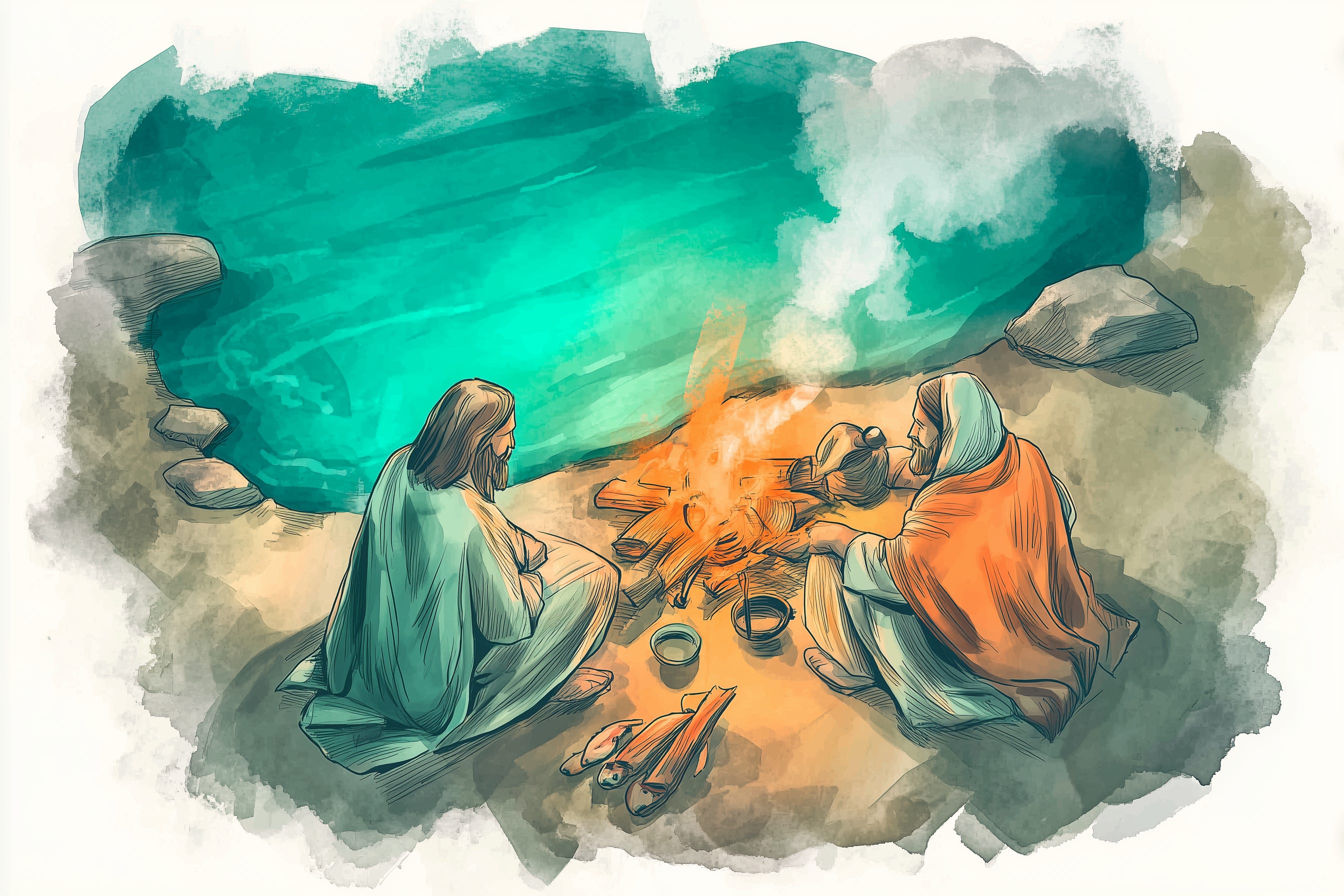

On a gray morning by the Sea of Galilee, mist drapes the waters and the chill of dawn lingers in the air. The risen Jesus crouches beside a small charcoal fire, the smoke curling upward and carrying the scent of roasted fish. He gestures warmly to the weary fishermen who have spent a long, fruitless night on the lake, inviting them closer to share in a simple yet holy breakfast. Their tired eyes widen with both astonishment and relief—it is the Lord.
Among them is Peter, his heart pounding with conflicting emotions. He remembers vividly the night of his bold promises, swearing undying loyalty, and the crushing weight of his threefold denial before the rooster crowed. Shame still burns like an ember inside him as he draws near to the fire where Jesus sits. Yet Jesus does not glare with accusation or rehearse the failure that haunts Peter. Instead, after the meal, He looks into Peter’s eyes with a love that pierces deeper than guilt and asks a single searching question: “Do you love me?” Not once, but three times. Each question is like a balm, undoing the knots of shame. Each response from Peter is received, not dismissed. Each answer is met with a commission—“Feed my lambs…tend my sheep…feed my sheep.”
Three questions. Three restorations. Three commissions. In this quiet encounter on the shoreline, Peter learns that failure does not cancel calling, and that love is the truest measure of a disciple’s heart (John 21:15–17).
If the cross has conquered sin and death, why do believers like Peter—and like us—still stumble?
If we are forgiven, why do old habits and accusations still feel so loud?
What does God call us when we fail—sinner or saint?
Start creating stunning images and videos with Imagine AI Art Generator

Saints by Calling, Not by Performance
The New Testament has one singular name for those who belong to Christ: saints—holy ones by calling, not by performance (1 Corinthians 1:2; Ephesians 1:1). Scripture never refers to believers in Christ as sinners except to describe who they were before they accepted Him. Therefore, in Christ, you are a new creation, not a cleaned‑up, covered or concealed version of the old (2 Corinthians 5:17). Your standing is a gift of grace: you are justified freely through the redemption that is in Jesus, not by your effort (Romans 3:24; Titus 3:5).
“Then Why Do I Still Sin?”
Because while your identity is new, your mind and habits are being retrained. When we became new creations in Christ, our spirits were made alive, but our minds were not instantly replaced. The patterns of thought, the reflexes of fear, doubt, shame, or pride still echo from the old life. There is therefore a real tug‑of‑war between flesh and Spirit (Galatians 5:17). Like Paul, you may cry, “I do not do the good I want” (Romans 7:19). Yet Scripture answers with assurance: your old self was crucified with Christ; you are to reckon yourself dead to sin and alive to God (Romans 6:6, 11). The battle is no longer about changing your identity—it is settled—but about renewing your perception of it.
This process is called sanctification: the ongoing renewal of the mind where old lies are uprooted and replaced with the unshakable truth of God’s Word. As the Spirit teaches, the heart learns to reject the whispers of the enemy and to embrace the voice of the Shepherd. You now live by Another’s life (Galatians 2:20), a life that empowers you to gradually see yourself and the world through heaven’s eyes. Practically, you put off the old ways—thoughts and behaviors rooted in falsehood—and put on the new, aligning your choices with what God has already declared to be true (Ephesians 4:22–24).
What doesn’t change is your no‑condemnation status in Christ (Romans 8:1) and the perfecting work He has already secured: “by a single offering He has perfected for all time those who are being sanctified” (Hebrews 10:14). When you sin, you have an Advocate—Jesus the righteous—whose atoning work is sufficient (1 John 2:1–2). We confess sins not to re‑earn justification but to walk in the reality of restored fellowship and light (1 John 1:9).
Renewed Minds, Transformed Lives
Jesus offered one sacrifice for sins and sat down on the throne—work complete (Hebrews 10:12). God now promises, “I will remember their sins no more” (Hebrews 10:17–18). Who can bring a charge against God’s elect? Christ has died, risen, and intercedes for you (Romans 8:33–34). This grace was foretold: “He was pierced for our transgressions … and with His wounds we are healed” (Isaiah 53:5–6).
Sanctification is not pretending to be holy or modifying outward behavior; it is thinking God’s thoughts until our lives harmonize with reality. Be transformed by the renewing of your mind (Romans 12:2). Train your attention toward what is true, honorable, just, pure, lovely, and praiseworthy (Philippians 4:8). Set your mind on things above, where your true life is hidden with Christ (Colossians 3:1–3).
The Enemy’s Fire: Old Lies, New Life
The devil cannot un‑resurrect Jesus or un‑adopt you, so he shoots fiery darts—accusations and lies—to lure you back into unbelief (Ephesians 6:16). He is a liar and the father of lies (John 8:44). Our warfare is chiefly about thoughts; we demolish arguments and take thoughts captive to Christ (2 Corinthians 10:4–5). Why are his lies powerless? Because at the cross God canceled the record of debt and disarmed the powers (Colossians 2:13–15). Jesus declared, “It is finished” (John 19:30).
These fiery darts often take the form of shame‑soaked memories, anxious projections about the future, or subtle whispers suggesting that God’s grace has limits. They attempt to distort your perception, making shadows look like giants. The battle therefore is not only defensive but also proactive—learning to clothe yourself daily in the armor of God, rehearsing His promises until they become the reflex of your heart. The lies lose their grip the moment they are dragged into the light of Scripture, where the truth exposes them as powerless threats.
Fear and Doubt: From Belief to Unbelief
Fear and doubt often creep in like fog, blurring our sight of the promises of God. When circumstances press and prayers feel unanswered, the heart may slip from belief into unbelief. The lies can feel so convincing—whispering that God has forgotten, that grace has run out, or that we are no longer loved. Yet even in such moments, saints can cling to the Truth. The gospel speaks louder than fear: You are forgiven (Romans 8:1), you are adopted (Ephesians 1:5), you are never forsaken (Hebrews 13:5), you are God’s masterpiece (Ephesians 2:10), you are more than a conqueror (Romans 8:37), and you are sealed with the Spirit (Ephesians 1:13). This is the truth about who God says you are, and God is not a liar.
These identity promises are anchors that hold when the waves of doubt crash against us. They remind us that our identity is not determined by our feelings but by God’s unchanging Word. As saints, we choose to live from truth rather than from fear’s illusion.
We are soldiers on the battlefield: shield raised, arrows clattering harmlessly against its surface. That is the believer’s stance when holding the shield of faith, soaked in the waters of God’s Word. The enemy cannot undo Christ’s resurrection or your adoption; he can only distract and discourage. But every reminder of the cross silences his accusations. Every declaration of God’s promises turns arrows into ashes.
Practicing Sainthood
Walk by the Spirit (Galatians 5:16). Fix your eyes on Jesus, lay aside every weight, and run with endurance (Hebrews 12:1–2). When you fall, fall toward Him. When accused, respond with truth. When tempted, answer with Scripture. When anxious, return to grace. Recalling that you are not working to become a saint—you are learning to live as one.
This practice requires more than momentary resolve; it is the daily shaping of our habits around the reality of who we already are in Christ. Saints cultivate rhythms of prayer, Scripture meditation, confession, and fellowship. They learn to replace reactive patterns of fear, doubt and shame with deliberate responses grounded in God’s promises. Living as a saint may mean slowing down enough to notice the Spirit’s prompting, or choosing to forgive when every impulse wants retaliation. It may mean seeing trials not as punishments but as opportunities to trust God’s sufficiency.
In community, practicing sainthood means bearing one another’s burdens, reminding brothers and sisters of their true identity, and encouraging faith when doubt creeps in. In solitude, it means learning to rest in God’s presence without striving. The more we align our thoughts and choices with the truth of our sainthood, the more our external lives reflect the internal reality God has declared over us.
Conclusion
The truth is you are your Father’s child. You make Him proud and you make Him smile. You were made in the image of a perfect King, He looks at you and wouldn’t change a thing. The truth is you are truly loved by a God who’s good when you’re not good enough. You don’t belong to the lies, You belong to Him; and that’s the truth.*
In Christ you live in the victory of the cross. Sin may still carry the day, but it no longer reigns. You are not a sinner trying to act like a saint; you are a saint who sometimes forgets who you are. Hold fast to the Truth. Trust God’s love beyond your performance. Accept his promises in scripture that you are fully free and forgiven, because the cross of Christ was—and is—enough.
Are you living as a sinner covered by grace instead of a saint in Christ’s victory? If so, pray this:
Father, I come to You in Jesus’ name. I confess that I’ve often defined myself by my failures, my moods, and my performance instead of by the finished work of Your Son. I have listened to accusations louder than Your promises and worn shame like a name tag. Today I renounce the lie that I am a hopeless sinner trying to earn Your love. I receive again the truth that, in Christ, I am a beloved saint—justified by grace, made new by Your Spirit, and secure in Your love.
Lord Jesus, thank You that Your cross canceled my debt, silenced my accusers, and opened a living way into the Father’s presence. Thank You that when I sin, You do not abandon me; You intercede for me. I bring my specific sins to Your light now and agree with You about them. Wash my feet, renew my mind, and restore joy to my obedience.
Holy Spirit, teach me to take every thought captive, to extinguish fiery darts with the shield of faith, and to set my mind on things above. Train my heart to run first to grace, not to hiding; first to prayer, not to self‑reliance. Lead me into habits that fit a saint—Scripture, fellowship, confession, service, and worship. I trust that You who began a good work in me will bring it to completion. In Jesus’ mighty name, amen.
*Adapted from lyrics from Megan Wood’s song The Truth.
Bibliography
John Stott, The Cross of Christ (IVP)
J. I. Packer, Knowing God (IVP)
Jerry Bridges, The Pursuit of Holiness (NavPress)
Neil T. Anderson, Victory Over the Darkness (Regal)
Neil T. Anderson, The Bondage Breaker (Harvest House)
Watchman Nee, The Normal Christian Life (Tyndale)
Neil T. Anderson, Who I Am in Christ (Regal)
John Piper, Counted Righteous in Christ (Crossway)
N. T. Wright, Justification (SPCK)
Neil T. Anderson, Walking in the Light (Bethany House)
Matt Chandler, The Explicit Gospel (Crossway)
Scripture References
John 21:15–17, 1 Corinthians 1:2, Ephesians 1:1, 2 Corinthians 5:17, Romans 3:24, Titus 3:5, Galatians 5:17, Romans 7:19, Romans 6:6, Romans 6:11, Galatians 2:20, Ephesians 4:22–24, Romans 8:1, Hebrews 10:14, 1 John 2:1–2, 1 John 1:9, Ephesians 6:16, John 8:44, 2 Corinthians 10:4–5, Colossians 2:13–15, John 19:30, Hebrews 10:12, Hebrews 10:17–18, Romans 8:33–34, Isaiah 53:5–6, Romans 12:2, Philippians 4:8, Colossians 3:1–3, Galatians 5:16, Hebrews 12:1–2