


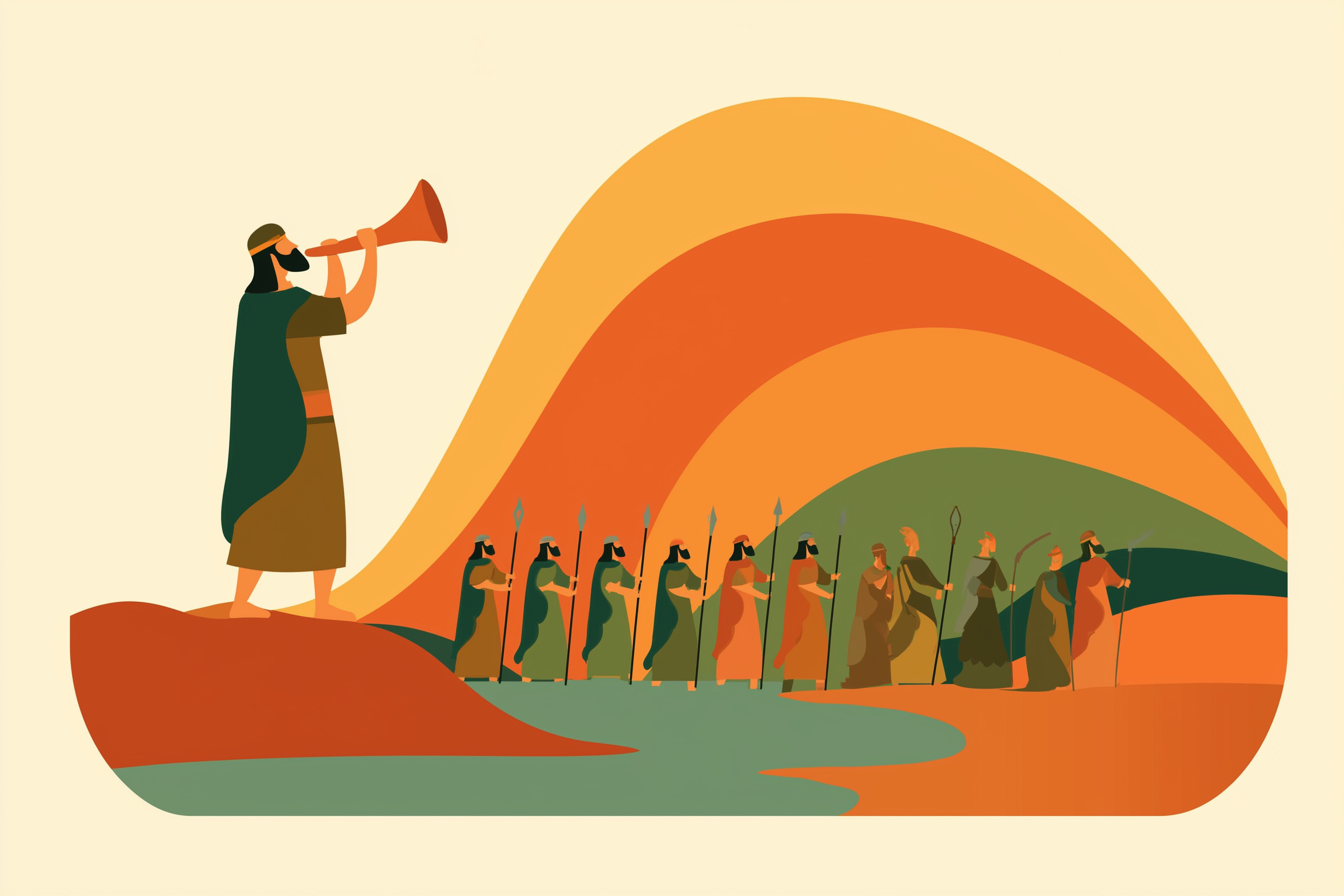

The Jordan River runs high, swollen at its banks, churning with the force of spring floodwaters. On the far side waits the land of promise, but between Joshua and that promise stands a river too deep to cross and a future too large to control. Behind him lies the memory of Moses, the servant of the Lord, now dead. Ahead of him are fortified cities, seasoned armies, and a calling heavy enough to crush an ordinary man. One can almost imagine Joshua standing in the twilight with the damp wind against his face, the sound of rushing water filling the silence, the weight of leadership pressing into his chest. Then the voice of God breaks through the fear: “Be strong and courageous... for the Lord your God is with you wherever you go” (Joshua 1:9).
Joshua’s first need was not a better strategy. It was not a larger army, clearer odds, or a guarantee that he would feel brave. His first need was the presence of God and the assurance that the One who called him would remain with him. Courage would not come from self-confidence. It would come from God’s presence and God’s promise.
How often do we live as though fear should be the one setting the agenda for our lives?
How often do we let anxiety name us, limit us, and shrink our obedience?
And what if the answer to fear is not found in becoming impressive, but in becoming settled in the grace of God?
What if acceptance in Christ is the very thing that makes courage possible?


We Fear Because We Forget Who Holds Us
Fear often grows in the soil of forgetfulness. We forget who God is, we forget what He has said, and we forget who we are in Christ. When identity slips, fear fills the vacuum. This is one of the great themes of the Identity series: the battle over our lives is often a battle over naming. The enemy’s first strike against Jesus in the wilderness was aimed at His identity: “If you are the Son of God...” (Matthew 4:3). The temptation was not merely about bread or spectacle. It was about whether Jesus would live from the Father’s declaration or feel the need to prove Himself.
That same battle continues for us. Fear thrives when we start listening again to the world’s labels, our past failures, or the enemy’s accusations. The world says we are what we accomplish, what others think, what we can secure, or what we can control. But the world’s labels never satisfy. They create anxious people because they create unstable identities. If acceptance must be earned, then fear will always whisper that it can be lost. If significance must be proven, then fear will always stalk our performance. If security must be constructed by our own hands, then fear will dominate every uncertain circumstance.
But the gospel speaks a better word. In Christ, identity is received, not achieved. We are not building a name for ourselves. We are have already been named by God.
Acceptance in Christ Silences Orphan Fear
The heart that does not know grace lives like an orphan. It may use Christian language, attend church, and affirm right doctrine, yet still functionally believe that everything depends on its own effort. That kind of heart is constantly vulnerable to fear because it does not know how to rest. It lives from anxiety because it does not know how to live from acceptance.
The apostle Paul writes, “For you did not receive the spirit of slavery to fall back into fear, but you have received the Spirit of adoption as sons” (Romans 8:15).
This is why acceptance matters so deeply in the fight against fear. If we believe we are still trying to earn God’s favor, then every hardship feels like rejection, every delay feels like disapproval, and every failure feels like exposure. We may start believing lies about God such as: God is angry with me, I have let God down, I am in danger of losing my salvation, I have to clean myself for God to accept me.
But if we know that we have already been accepted in the Beloved through Christ, then hardship may still hurt, delay may still confuse, and failure may still grieve me, but none of them can define us. The Father’s verdict over our lives is no longer hanging in suspense.
We were designed to receive identity from God, not manufacture it for ourselves. That truth does not merely help us conceptually. It steadies us practically. Fear loses some of its grip when the soul becomes convinced that God’s love is not up for negotiation.
God’s Presence Is the Ground of Courage
Joshua 1:9 is not a motivational slogan detached from theology. It is a command rooted in presence: “Be strong and courageous....” if the verse ended there, it would only speak to what God expected of us. But the scripture continues with “for the Lord your God is with you wherever you go.” This means our courage and strength are not derived from us, they are achieved in relationship. In this verse, God does not tell Joshua to ignore danger, deny difficulty, or pretend weakness does not exist. He tells him to be strong because God Himself will be with him.
That pattern runs throughout Scripture. God’s people are strengthened not by an inflated view of themselves, but by a right view of God’s nearness. Moses could face Pharaoh because God said, “I will be with you” (Exodus 3:12). Israel could move toward Canaan because the Lord went before them. David could face Goliath not because he thought highly of his own power, but because he knew the battle belonged to the Lord (1 Samuel 17:47). Mary could receive a humanly impossible calling because “nothing will be impossible with God” (Luke 1:37). Paul could endure weakness because Christ’s power rested upon him (2 Corinthians 12:9).
Fear tells us that we are alone. Grace tells us that we are accompanied by God and abiding in relationship with Him.
This is one reason fear can become so spiritually disorienting. Fear narrows our vision until all we can see is the size of the obstacle. Grace widens our vision until we remember the presence of God. The question is not whether the river is deep, the city is fortified, or the future is uncertain. The deeper question is whether God is present. And for those in Christ, the answer is yes.
Jesus told His disciples, “I am with you always, to the end of the age” (Matthew 28:20). That promise means courage is never the product of isolation. The Christian is never abandoned to face life alone. The risen Christ has not only forgiven us; He has joined Himself to us. He is Immanuel, God with us, and by His Spirit He remains in us.
Grace Gives Power, Love, and Sound Judgment
Fear is not only emotional. It often becomes directional. It starts deciding what we will avoid, what we will postpone, what we will refuse to confront, and where we will not trust God. That is why fear is not just something we feel. It can become something we obey.
Paul confronts this in 2 Timothy 1:7: “for God gave us a spirit not of fear but of power and love and self-control.” The phrase self-control can also carry the sense of a sound mind, sober judgment, or disciplined thinking. In other words, fear does not come to us as a gift from God. The grace of God gives something different. It gives power to endure and obey, love that refuses to collapse inward, and sound judgment that keeps us from being ruled by panic.
Notice how beautifully this speaks into the identity themes we have already explored. Grace does not merely tell us to stop being afraid. Grace gives us what fear cannot produce.
It gives us power. Not worldly domination, not self-exalting strength, but Spirit-given strength to remain faithful.
It gives us love. Fear curves us inward. Love moves us outward. Fear becomes obsessed with self-protection. Love remembers God and neighbor.
It gives us sound judgment. Fear is often irrational, exaggerated, and disorienting. It magnifies what may happen and minimizes what God has promised. But grace sobers us. It teaches us to think in truth.
A fear-governed life is unstable because fear is a poor shepherd. It reacts, withdraws, distorts, and often lies. But the Spirit of God leads us differently. He does not make us reckless, but He does make us free.
Fear and the False Need for Control
Much of our unhealthy fear is tied to control. We want to know how things will turn out. We want guarantees before obedience. We want enough information to protect ourselves from dependence. But grace does not train us to control our lives. Grace trains us to trust the Father.
This was true in Eden and it is true now. Humanity reached for autonomy because it doubted God’s goodness. Fear still operates in that same old pattern. It tells us that God’s presence is not enough, His Word is not enough, His care is not enough, and so we must secure ourselves through worry, manipulation, avoidance, or striving. Fear often feels practical, but underneath it frequently lies unbelief.
This does not mean every fear response is simple rebellion. Some fears are intensified by trauma, betrayal, suffering, or long seasons of pain. Broken bodies and wounded minds can carry fear in very deep ways. We should speak with compassion, not cruelty. Yet even there, the invitation of grace remains. God does not shame His children for being weak. He meets them in their weakness and patiently teaches them to rest in His strength.
The answer to fear is not becoming emotionally invincible. It is becoming increasingly dependent on the One who is.
The Cross Proves We Are Safe in God’s Love
If fear asks whether God will really hold us, the cross answers with blood-bought certainty. Romans 8 moves from adoption to assurance and then anchors both in the love of God revealed in Christ. “He who did not spare his own Son but gave him up for us all, how will he not also with him graciously give us all things “ (Romans 8:32). If the Father has already given His Son for us, then the deepest question of acceptance has already been settled. The cross is not God withholding Himself from us. It is God pouring Himself out for us.
That means the believer’s ultimate safety is not found in favorable circumstances. It is found in the unbreakable love of God in Christ Jesus. Later in Romans 8, Paul asks whether tribulation, distress, persecution, famine, nakedness, danger, or sword can separate us from the love of Christ. His answer is emphatic: no. “For I am sure that neither death nor life... nor anything else in all creation, will be able to separate us from the love of God in Christ Jesus our Lord” (Romans 8:38–39).
This is not theoretical comfort. This is the death of fear’s absolute claims. Fear can still bark, but it can no longer rule as though abandonment were possible. If I belong to Christ, I am held. If I am held, then fear does not get to define reality. It may still visit me, but it is no longer my master.
Courage Is Not the Absence of Fear but the Refusal to Bow to It
Many believers assume courage means feeling no fear at all. But biblically, courage is often obedience in the presence of fear. Joshua likely felt the weight of his task. David knew the size of Goliath. Esther knew the risk of approaching the king. Paul knew what suffering awaited him in city after city. Courage is not naivety. It is faithful movement rooted in God’s character and promise.
This matters because some of us wait for fearlessness before we obey. We postpone the hard conversation, the step of faith, the act of repentance, the needed boundary, the calling God has put before us, because we assume courage must feel clean and easy before it is real. But courage often trembles. Courage often prays with sweaty palms. Courage often says, “Lord, I believe; help my unbelief” (Mark 9:24).
Living from acceptance means I no longer need fear to disappear before I obey. I only need to remember whose I am.
The one accepted by grace can repent courageously because failure is not final condemnation.
The one accepted by grace can love courageously because rejection is not the end of the story.
The one accepted by grace can endure courageously because suffering is not proof of abandonment.
The one accepted by grace can speak truth courageously because the Father’s approval matters more than man’s applause.
The one accepted by grace can trust in God’s provision courageously because the Father promises to provide and He is trustworthy.
The one accepted by grace can believe they are not alone courageously because the Father promises to He will never leave or forsake us.
The one accepted by grace can overcome courageously because the Father promises He will fight our battles for us.
Spiritual Warfare Is Often a Battle Over Fear
At Creation Awaits, we regularly emphasize that identity is contested ground. Satan traffics in lies, and one of his most common lies is fear. He tells us that obedience will destroy us, surrender will diminish us, confession will ruin us, generosity will leave us empty, and trust will make us unsafe. In this sense, fear is often deeply connected to spiritual warfare.
The enemy’s language has not changed much since Eden. Principalities and Powers still attack God’s goodness, God’s Word, and God’s intentions toward us. If he can get us to believe that God is withholding, absent, unreliable, or unkind, cruel, uncaring, passive or cold, fear will do the rest. Once fear governs the imagination, compromise begins to look reasonable and your trust in God falters.
That is why the armor of God begins with truth (Ephesians 6:14). The battle is not first against circumstances, but against lies. And the truth is this: in Christ, we are beloved, adopted, sealed, and kept. We do not fight for acceptance. We fight from acceptance.
That changes how we resist fear. We do not merely grit our teeth. We answer fear with truth. We preach God’s character to our anxious hearts. We remind ourselves that we have not received a spirit of slavery to fall back into fear. We remember that the Shepherd who called us will not lose us.
Conclusion
Joshua stood on the edge of impossibility and heard the command to be strong and courageous, not because the future was easy, but because the Lord would be with him. That same pattern still shapes the life of grace. We do not have to allow unhealthy fears to control us or set the agenda in our lives because God is all-powerful, ever-present, and faithful to His children. In Christ, we have been accepted, adopted, and secured in the love of the Father. That acceptance does not make us passive. It makes us courageous.
Fear feeds on uncertainty, self-reliance, and forgetfulness. Grace answers all three. Grace reminds us that our identity is received, not achieved. Grace teaches us that God’s presence is better than our illusions of control. Grace gives us the gifts of power, love, and sound judgment. Grace anchors us at the cross, where God forever settled the question of His love for us. And grace teaches us that courage is not the absence of trembling, but faithful obedience in the presence of it.
To live from acceptance means we no longer have to bow before every anxious possibility. We no longer have to build our lives around avoidance. We no longer have to let fear become our master. We can be strong and courageous because the Lord our God is with us wherever we go.
Are you living as though fear has more authority over your life than the grace of God? Are you allowing anxiety, self-protection, or the need for control to set the agenda instead of the presence and promises of the Father? If so, pray this prayer:
Father, I come before You confessing that I have often let fear lead me more than faith. I have allowed anxious thoughts to shape my decisions, unhealthy fears to rule my imagination, and uncertainty to steal my peace. I confess that I often act as though everything depends on me. I try to secure my own future, protect my own heart, and control outcomes that only You can hold. Forgive me for the ways I have forgotten who You are and forgotten who I am in Christ.
Lord, thank You that in Jesus I am not a slave living under fear, but an adopted child welcomed into Your household by grace. Thank You that I do not have to perform for Your love, earn Your acceptance, or prove my worth before You. Thank You that the cross has forever settled the question of whether You are for me. You did not spare Your own Son, but gave Him up for me. So teach my heart to rest in what You have already declared over my life. Teach me to live from acceptance instead of striving for it.
Jesus, where fear has lied to me, speak truth. Where fear has made me withdraw, teach me to trust You. Where fear has made me controlling, teach me surrender. Where fear has made me silent, give me courage to obey. Fill me with the grace gifts of power, love, and sound judgment. Strengthen what is weak in me. Reorder what is disoriented in me. Heal the places where fear has become deeply rooted through pain, disappointment, or old wounds. Be gentle with my weakness, but do not leave me in bondage.
Holy Spirit, train me to recognize the voice of fear and answer it with the truth of God’s Word. Remind me that I am held, that I am loved, that I am not alone, and that nothing can separate me from the love of God in Christ Jesus. Teach me to be strong and courageous, not because I am naturally brave, but because the Lord my God is with me wherever I go. Let my life no longer be governed by panic, avoidance, or self-reliance, but by trust, obedience, and peace. In the mighty name of Jesus, amen.
Bibliography
J. I. Packer, Knowing God.
Dane C. Ortlund, Gentle and Lowly.
Jerry Bridges, Transforming Grace.
Neil T. Anderson, Victory Over the Darkness.
Sinclair B. Ferguson, Children of the Living God.
Rankin Wilbourne, Union with Christ.
Timothy Keller, The Freedom of Self-Forgetfulness.
John Stott, The Cross of Christ.
A. W. Tozer, The Knowledge of the Holy.
Andrew Murray, Humility.
Paul E. Miller, A Praying Life.
Dane Ortlund, Deeper.
Scripture References
Joshua 1:9, Matthew 4:3, Romans 8:15, Exodus 3:12, 1 Samuel 17:47, Luke 1:37, 2 Corinthians 12:9, Matthew 28:20, 2 Timothy 1:7, Romans 8:32, Romans 8:38–39, Mark 9:24, Ephesians 6:14